Assessing the effect of ethnicity and socioeconomic status on outcomes in asthma – A systematic review – The impact of targeted interventions (ID 732)
University of Nottingham
Abstract
Background
Socioeconomic disadvantage and minority ethnicity are consistently associated with poorer asthma outcomes. However, less is known about whether these outcomes improve when interventions address barriers related to deprivation. This review synthesised evidence from interventional studies conducted primarily within socioeconomically disadvantaged and/or minority ethnic adult populations to assess whether targeted interventions improve asthma outcomes in these populations.
Methods
Ovid MEDLINE, Ovid Embase and Web of Science were searched between July 2023 and September 2025 (final search 26/09/2025) for studies published from January 1998. Experimental and quasi-experimental studies were eligible if they evaluated interventions delivered primarily to socioeconomically disadvantaged and/or minority ethnic adult populations.
Screening and data extraction used prespecified criteria. Risk of bias was assessed using ROBINS-I. Emergency department attendances and asthma related hospitalisations were selected for quantitative synthesis. Risk ratios (RRs) were calculated and pooled using random-effects meta-analysis. Outcomes reported heterogeneously were synthesised narratively.
Results
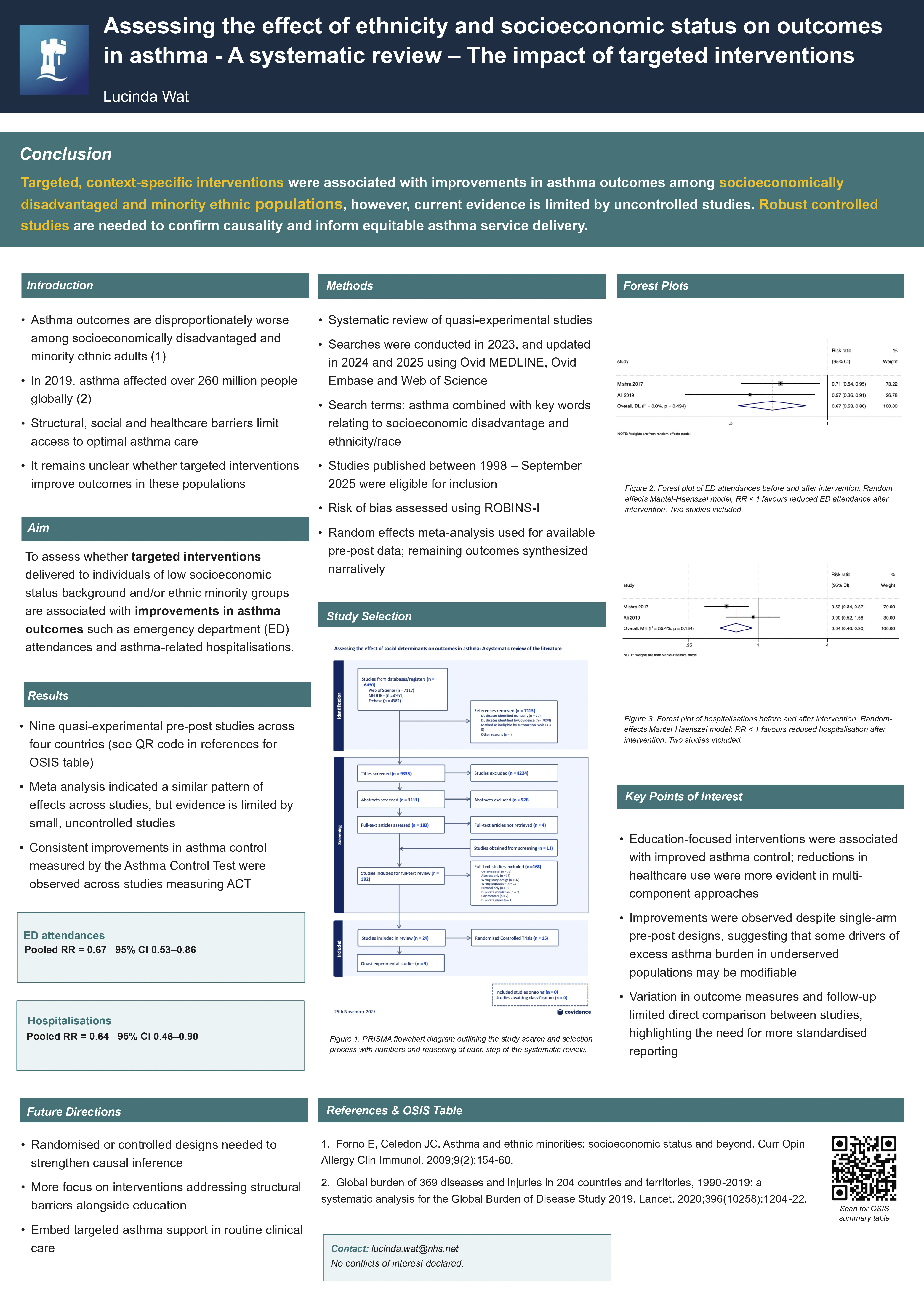
Nine quasi-experimental pre-post studies met the inclusion criteria. Interventions were heterogeneous, commonly including asthma education, self-management support and specialist service delivery. Most studies were judged to have serious risk of bias, primarily due to uncontrolled pre-post designs. Two studies contributed to the meta-analysis of emergency department attendances, which was associated with reduced ED use (pooled RR = 0.67 95% CI 0.53-0.86). Two studies contributed to the meta-analysis of hospitalisations, which was associated with reductions (pooled RR = 0.64 95% CI 0.46-0.90). Asthma control and other outcomes improved across studies, although differences in outcome measurement prevented quantitative pooling.
Conclusions
Across diverse settings, interventions delivered to socioeconomically disadvantaged and minority ethnic adult populations were associated with improvements in asthma outcomes. Findings are limited by uncontrolled pre-post designs which restrict causal inference. However, the consistent direction of effect suggests that some of the excess asthma burden in underserved groups may be modifiable through targeted interventions. More robust, comparative studies are needed to confirm these findings and guide implementation.
Funding: None
Conflicts of interest: None