🏅 Scientific Research Poster Winner
Optimising respiratory care in primary and community settings: a mixed methods study (ID 733)
University of Southampton
Abstract
Background:
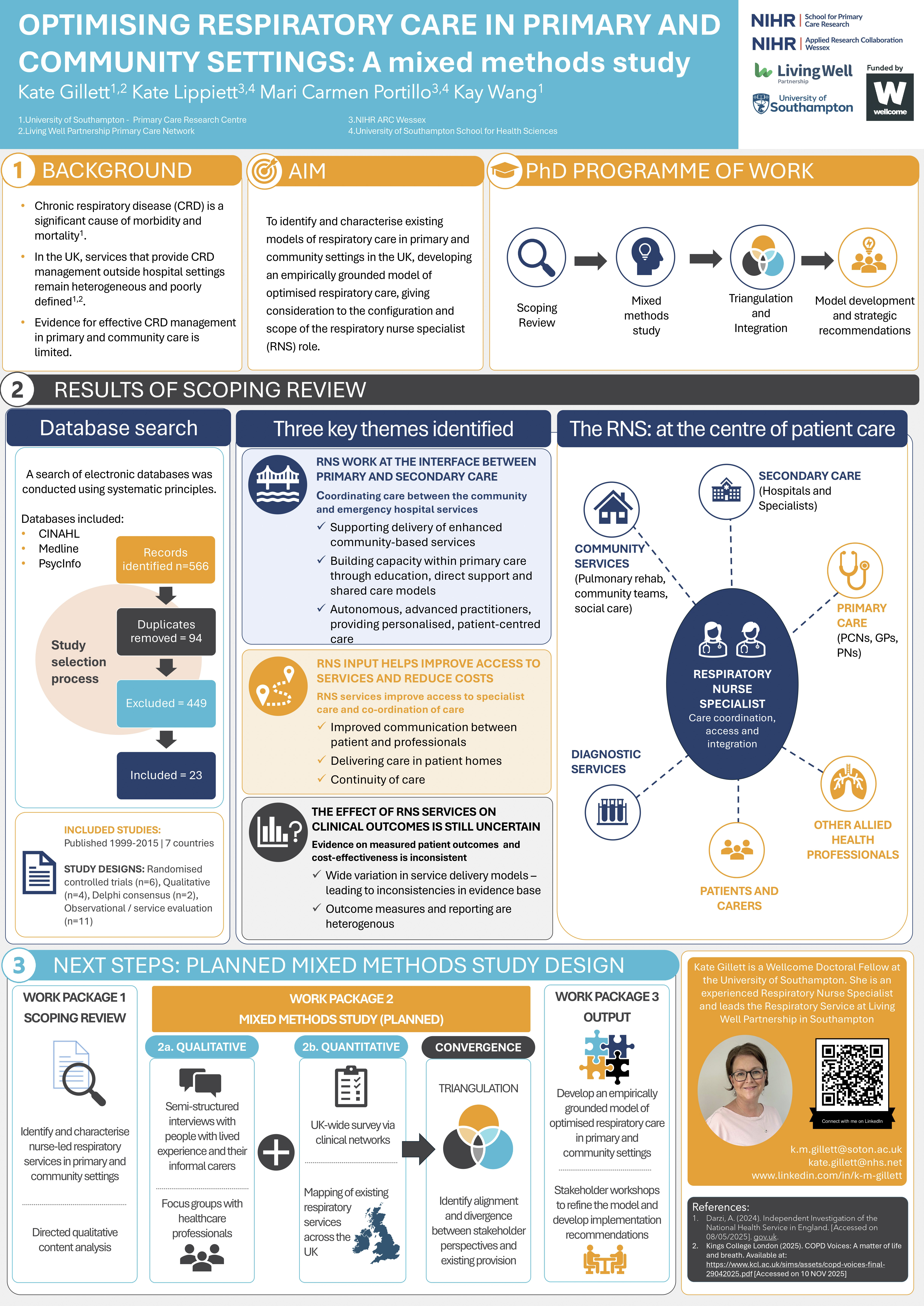
Chronic respiratory disease (CRD) is a significant cause of morbidity and mortality. In the UK, services that provide CRD management outside hospital settings remain heterogeneous and poorly defined. Evidence for effective CRD management in primary and community care is limited.
Aim:
To identify and characterise existing models of respiratory care in primary and community settings in the UK, developing an empirically grounded model of optimised respiratory care, giving consideration to the configuration and scope of the respiratory nurse specialist (RNS) role.
Methods:
We conducted a scoping review of the literature identifying and characterising nurse-led respiratory services for adults in community or primary care settings. Data were extracted and analysed using directed qualitative content analysis, informing a future mixed methods study using convergent design. We will conduct qualitative semi-structured interviews with people with lived experience of CRD and their informal carers, alongside focus groups with healthcare professionals, to explore current experiences and perceptions of respiratory care in primary and community settings. A quantitative survey will be distributed using clinical and research networks to map existing services across the UK. We will triangulate findings to identify areas of alignment and divergence between stakeholder conceptualisations of optimised care and existing service provision. We will synthesise these findings to develop a model for optimised respiratory care in primary and community settings, using workshops with key stakeholders to refine the model and identify strategic recommendations for implementation.
Results:
We identified three key themes through our scoping review: 1) RNSs work at the interface between primary and secondary care, improving access to services and reducing healthcare utilisation; 2) there are diverse service models, variable professional roles and inconsistent outcome reporting; 3) the effect of RNS services on clinical outcomes is still uncertain. These findings have informed the design of the planned mixed methods study.
Conclusion:
This body of work will characterise a model of optimised respiratory care in primary and community settings in the UK and develop understanding of the role of the respiratory nurse specialist in CRD management in these settings.
Funding: This PhD project is funded by the Wellcome Trust, through the NIHR School for Primary Care Research.
Conflicts of interest: None