Vibrating Mesh Nebulisation Versus Alternative Aerosol Delivery Methods During Non-Invasive Ventilation in Chronic Obstructive Pulmonary Disease: A Systematic Review (ID 767)
University of Buckingham
Abstract
Background
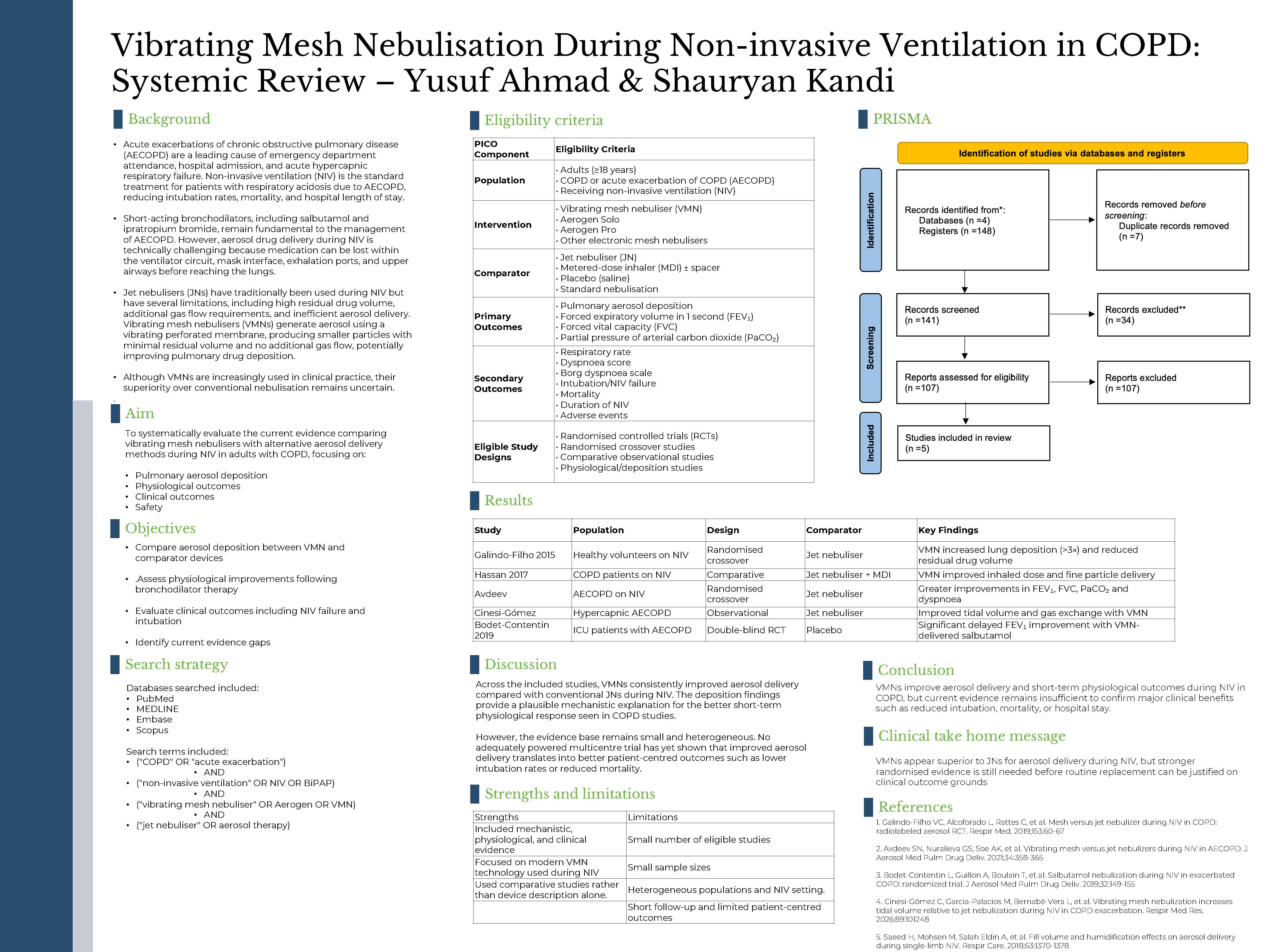
Acute exacerbations of chronic obstructive pulmonary disease (AECOPD) are a major cause of hospital admission and acute hypercapnic respiratory failure. Non-invasive ventilation (NIV) is a cornerstone of management in patients with respiratory acidosis secondary to COPD exacerbations. Concurrent administration of aerosolised bronchodilators is recommended; however, drug delivery during NIV is challenging because substantial aerosol losses may occur within the ventilator circuit, mask interface, and upper airways. Vibrating mesh nebulisers (VMNs) have emerged as an alternative to conventional jet nebulisers (JNs) because they produce a more consistent particle size distribution, have lower residual drug volumes, and do not require additional gas flow.
Objective
To evaluate the available evidence regarding the efficacy, physiological effects, aerosol deposition characteristics, and clinical outcomes associated with vibrating mesh nebulisation during NIV in patients with COPD.
Methods
A systematic review of comparative studies evaluating VMN during NIV in COPD patients was performed. Eligible studies included randomised controlled trials, crossover studies, observational studies, and physiological deposition studies. Outcomes included aerosol deposition, pulmonary function, gas exchange, respiratory parameters, safety outcomes, and clinical endpoints.
Results
Five studies met inclusion criteria. Deposition studies consistently demonstrated significantly greater pulmonary aerosol delivery with VMN than with JN. Physiological studies showed improvements in FEV₁, FVC, respiratory rate, dyspnoea scores, and PaCO₂. One randomised placebo-controlled trial demonstrated that bronchodilator administration through a VMN during NIV was feasible, safe, and associated with modest improvements in FEV₁. Evidence for improvements in clinically important outcomes such as intubation, NIV failure, mortality, and hospital length of stay remains limited.
Conclusion
Current evidence suggests that VMN provides superior aerosol delivery and short-term physiological benefit compared with conventional aerosol delivery methods during NIV. However, evidence supporting major clinical benefits remains insufficient and larger randomised controlled trials are required.
Funding: None
Conflicts of interest: None