Enhancing early diagnosis and management of COPD in deprived communities across Wakefield, UK. (ID 770)
Health Innovation Yorkshire & Humber
Abstract
Background:
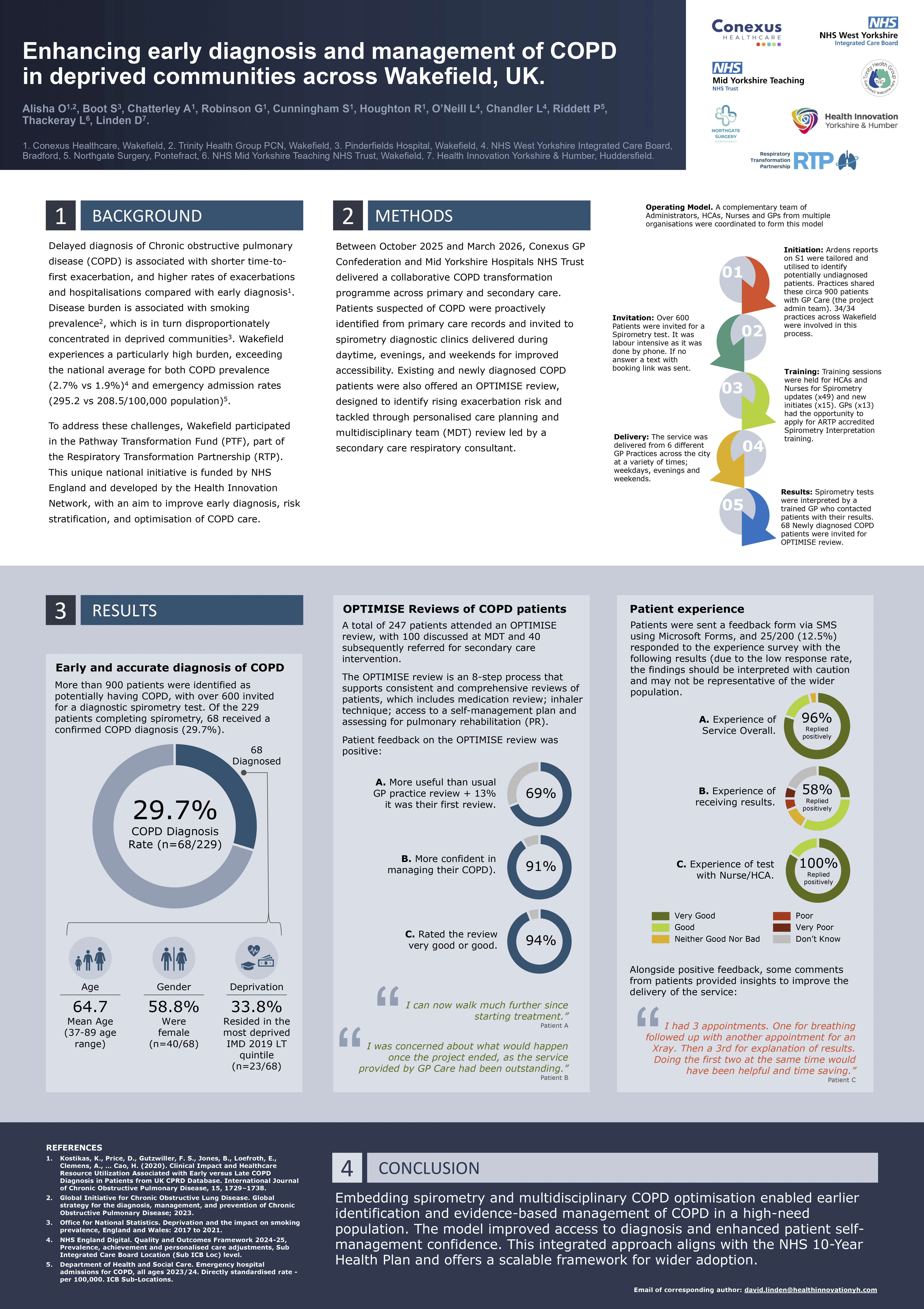
Delayed diagnosis of Chronic obstructive pulmonary disease (COPD) is associated with shorter time-to-first exacerbation, and higher rates of exacerbations and hospitalisations compared with early diagnosis[1]. Disease burden is associated with smoking prevalence[2], which is in turn disproportionately concentrated in deprived communities[3]. Wakefield experiences a particularly high burden, exceeding the national average for both COPD prevalence (2.7% vs 1.9%)[4] and emergency admission rates (295.2 vs 208.5/100,000 population)[5]. To address these challenges, Wakefield participated in the Pathway Transformation Fund (PTF), funded by NHS England and developed funded by the Health Innovation Network, to improve early diagnosis, risk stratification, and optimisation of COPD care.
Methods:
Between October 2025 and March 2026, Conexus GP Confederation and Mid Yorkshire Hospitals NHS Trust delivered a collaborative COPD transformation programme across primary and secondary care. Patients suspected of COPD were proactively identified from primary care records and invited to spirometry diagnostic clinics delivered during daytime, evenings, and weekends for improved accessibility. Existing and newly diagnosed COPD patients were also offered an OPTIMISE review, designed to identify rising exacerbation risk and tackled through personalised care planning and multidisciplinary team (MDT) review led by a secondary care respiratory consultant.
Results:
More than 900 patients were identified as potentially having COPD, with over 600 invited for diagnostic spirometry. Of the 229 patients completing spirometry, 68 received a confirmed COPD diagnosis (29.7%). Newly diagnosed patients had a mean age of 64.7 years (range 37–89); 58.8% were female (n=40) and 41.2% male (n=28). Socioeconomic deprivation was prominent with 33.8% (n=23) residing in the most deprived quintile and 22.1% (n=15) in the second most deprived quintile. A total of 247 patients attended an OPTIMISE review, with 100 discussed at MDT and 40 subsequently referred for secondary care intervention. Patient-reported outcomes indicated that 91% felt more confident managing their COPD following review.
Conclusions:
Embedding spirometry and multidisciplinary COPD optimisation enabled earlier identification and evidence-based management of COPD in a high-need population. The model improved access to diagnosis and enhanced patient self-management confidence. This integrated approach aligns with the NHS 10-Year Health Plan and offers a scalable framework for wider adoption.
Funding: This initiative was funded by the Pathway Transformation Fund 1: Winter 2025/26 that was provided by NHS England. This is part of the Respiratory Transformation Partnership (RTP), a unique national initiative developed by the Health Innovation Network, NHS England and the Office for Life Sciences, with industry partners.
Conflicts of interest: None.