🏅 Patient Centred Poster Winner
Health beliefs, euphemistic terms and colloquial expressions surrounding asthma diagnoses encountered in primary care (ID 772)
Imperial College Healthcare NHS Trust, London
Abstract
Context:
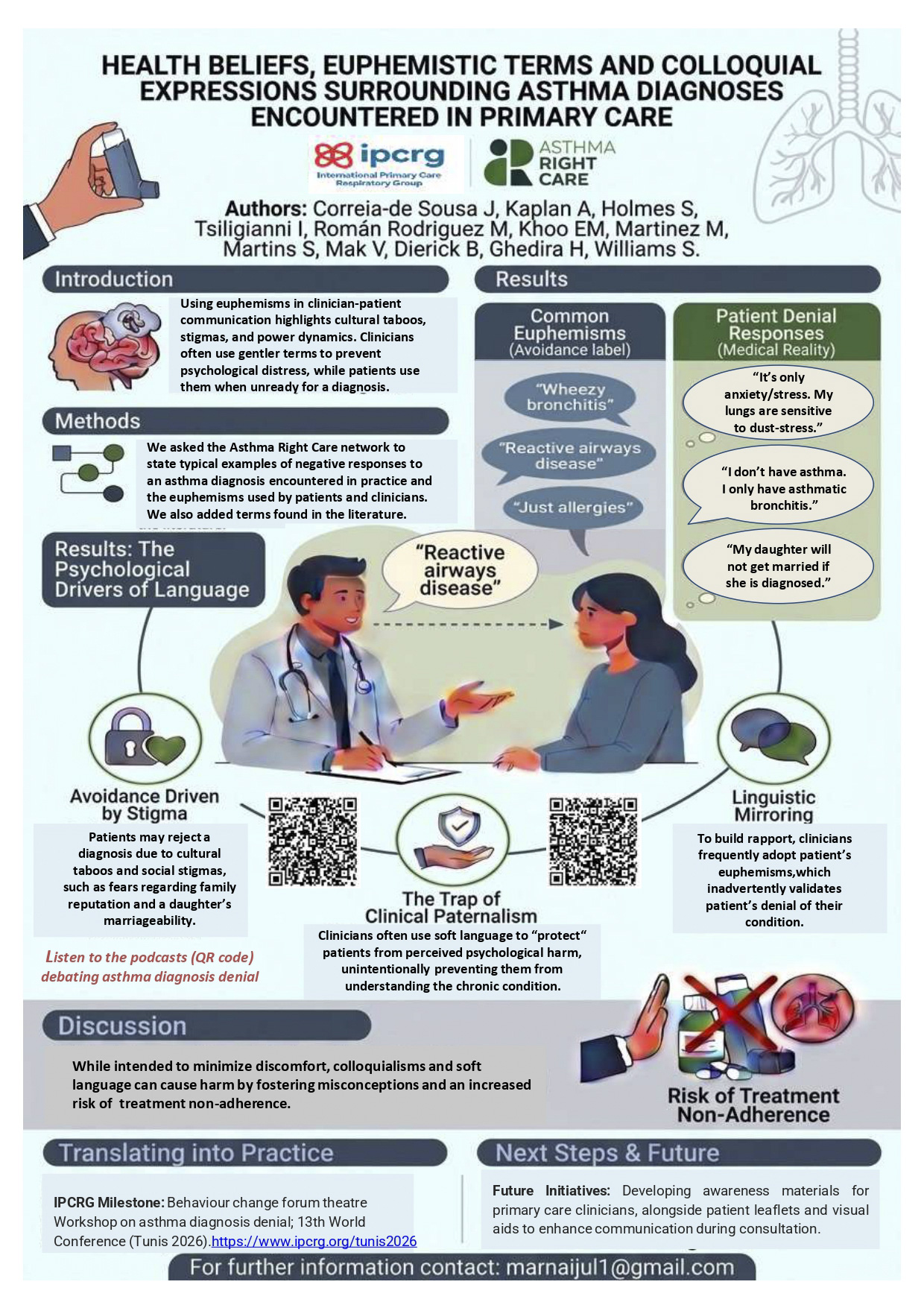
The use of euphemisms and colloquial expressions in clinician-patient communication is not a mere linguistic idiosyncrasy; rather, it reveals underlying behaviours by which we observe prevailing health beliefs, cultural taboos, social stigmas, and power dynamics within the clinical encounter.
Communicating a diagnosis may lead to denial from patients who does not want to have a medical label to their condition or prefer a socially acceptable euphemism.
Doctors with a paternalistic approach may use euphemisms because they think plain language can psychologically harm people by conveying a greater seriousness. It is also common for patients and doctors to avoid talking about the reality of the condition. Patients use euphemisms to show they are not yet comfortable with the diagnosis, and doctors mirror the language.
Euphemisms seem more gentle and are meant to minimize patient’s emotional discomfort and protective of the patient's experience. However, using euphemisms can cause harm, leading to misconceptions, misinformed health beliefs and non-adherence to treatment.
This project examines similarities and differences in health beliefs behind each term used for asthma in different countries . This will help raise awareness among clinicians of the importance in terms used during communication of diagnosis and treatment in consultation.
Methods:
We asked the Asthma Right Care network to state typical examples of negative responses to an asthma diagnosis encountered in practice and the euphemistic terms used by patients and clinicians. We also added terms found in the literature.
Results:
Examples of euphemisms:
● Wheezy bronchitis
● Reactive airways disease
● Just allergies/cough
Examples of denial responses:
● No, I know what asthma is and I don’t have it! I only have asthmatic bronchitis.
● My daughter will not get married if she is diagnosed with asthma.
● It’s only anxiety. My lungs are very sensitive to stress
Discussion:
We collected common euphemistic terms and explored the terms specific to the countries or cultures, and some which are more broadly used in different countries in order to develop tools and programmes to improve communication..
Funding: None
Conflicts of interest: None