Practise what you preach: an assessment of asthma self-management amongst medical students at the Hull York Medical School (ID 776)
Hull York Medical School
Abstract
Background
Asthma remains one of the most common chronic conditions affecting young adults in the UK and, despite effective treatments, preventable asthma deaths continue to occur. Medical students receive in-depth training on asthma management and are expected to counsel patients on optimal disease control. Yet, it is unclear whether they apply the same guideline-based principles to the management of their own asthma. This study aimed to assess whether asthma self-management among medical students at Hull York Medical School (HYMS) aligns with the advice they provide to patients. Do medical students practise what they preach?
Methods
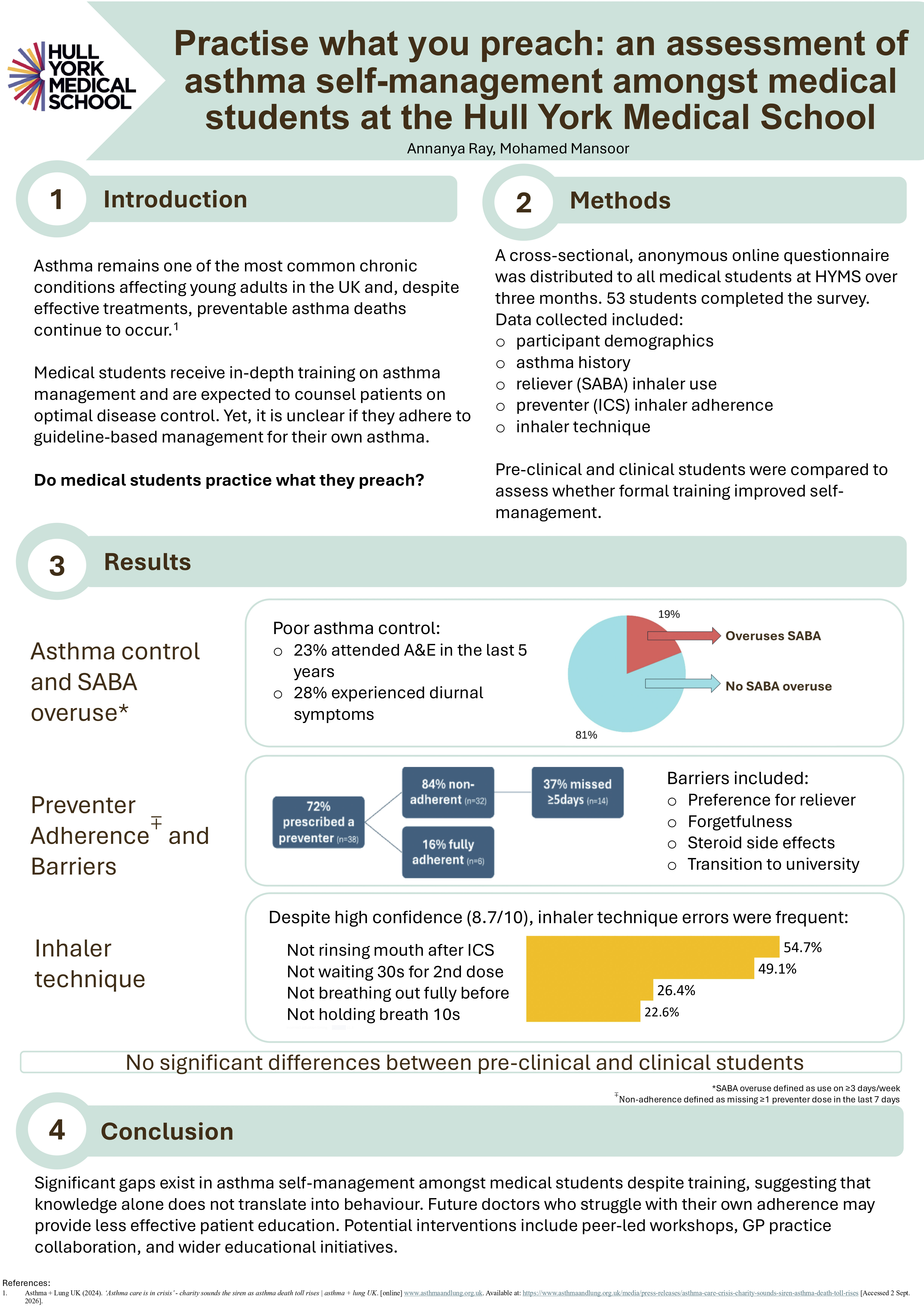
A cross-sectional, anonymous online questionnaire was distributed to all medical students at HYMS over three months. Data collected included demographics, asthma history, reliever (SABA) inhaler use, preventer (ICS) inhaler adherence and inhaler technique. SABA overuse was defined as use on ≥3 days/week. Pre-clinical and clinical students were compared to assess whether formal training improved self-management.
Results
53 students completed the survey. SABA overuse was noted in 19% (n=10). 23% (n=12) attended A&E in the last 5 years due to an asthma exacerbation. Of those who were prescribed a preventer inhaler (72%, n=38), only 16% (n=6) were fully adherent. Common barriers included preference for reliever due to faster relief, forgetfulness, side effects from steroids and transition to university (negatively affecting 21%, n=11). Despite high self-reported confidence (8.7/10) on inhaler technique, mistakes were common. No significant differences were observed between pre-clinical and clinical students for any outcome.
Conclusion
There are significant gaps in asthma self-management amongst medical students despite their training, indicating that knowledge alone does not necessarily translate into positive health behaviours. Given the ongoing challenge of preventable asthma morbidity and mortality in young people, these findings highlight an important opportunity for intervention within university populations. Future doctors who struggle with their own adherence may provide less effective patient education or underestimate the importance of optimal self-management. Further research across multiple medical schools is needed to determine whether these findings are generalisable. Potential interventions include peer-led workshops, collaboration with university and community GP practices, and wider educational initiatives aimed at improving asthma outcomes among students.
Funding: None
Conflicts of interest: None