Strategies to support BTS/NICE/SIGN NG245 Asthma guideline implementation and adoption (ID 787)
NHS Humber Health Partnership
Abstract
Background and Aim
Evidence demonstrates a link between over-use of short-acting beta-agonist (SABA) inhalers (three or more canisters per year) and risk of asthma exacerbation and death. Recent asthma guidelines support anti-inflammatory reliever (AIR) based regimens and a shift away from short-acting beta-agonist (SABA) reliever use. However, these and other elements of routine care are often poorly delivered by practitioners and poorly accepted by patients.
Aim: To assess barriers and facilitators and co-design a theoretically underpinned, implementation and health behaviour change strategies to support primary care practitioners and patients deliver or adopt guideline driven care
Methods
Building on an existing evidence-based quality improvement frameworks, systematic reviews of the literature and using psychological theory to inform interviews with primary care practitioners and patients, we conducted focus groups with primary care practitioners and patient to co-design strategies to support guideline implementation and adoption. Online focus groups with practitioners (n=12) and patients (n=12) confirmed and systematically considered solutions to previously identified barriers and means of enhancing facilitators to the delivery or adoption of guideline focused asthma care.
Results
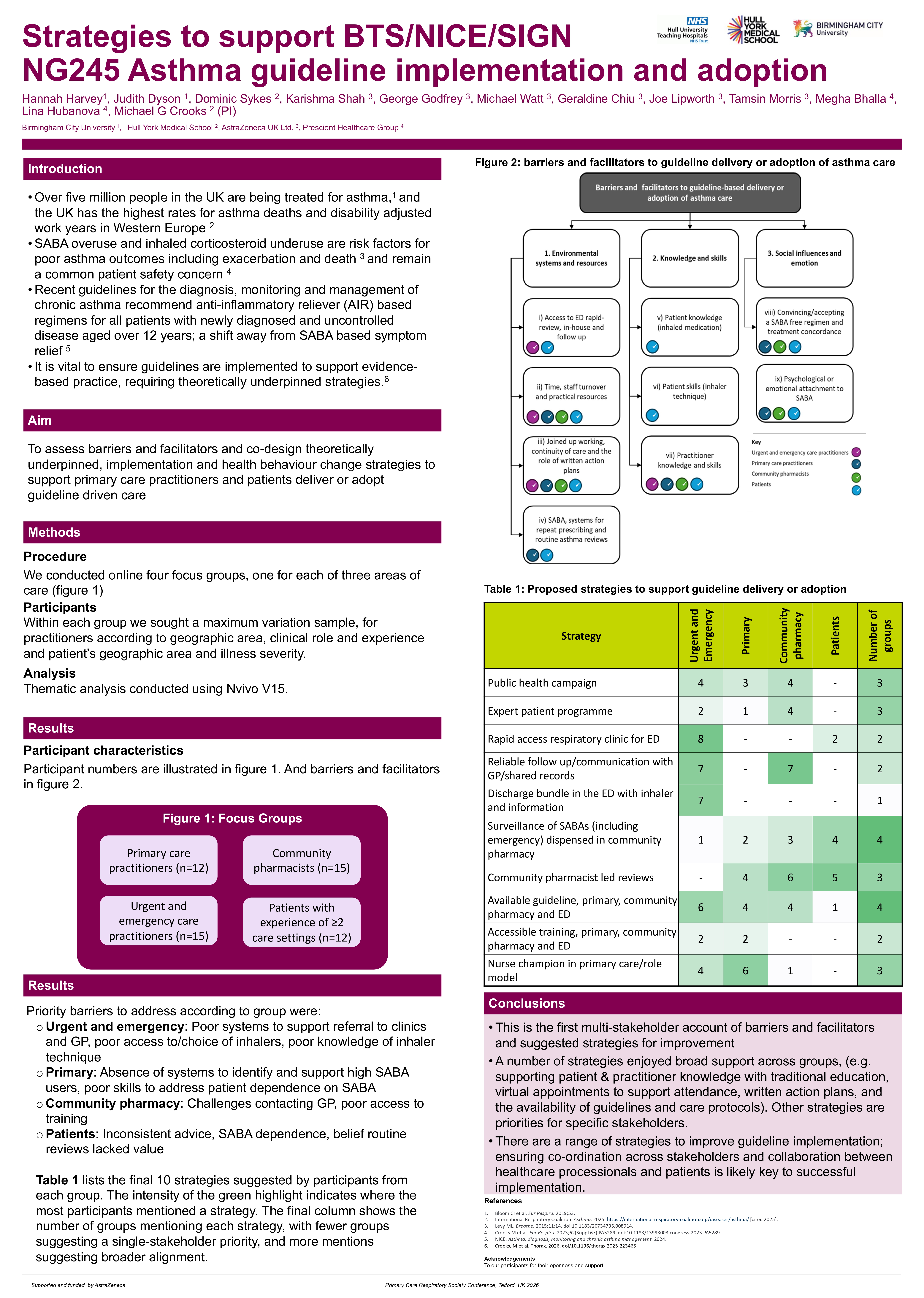
Barriers and facilitators for practitioners included: Variable systems to identify and support high SABA users, SABA on repeat prescription, time, variable access to spirometry and FeNO, variable knowledge, poor skills in supporting patients with SABA free medication changes, patient dependence on SABA.
Strategies to support practitioners included: dedicated asthma nurses, SABA not routinely on repeat prescription, communication skills training, triage/prioritisation systems to support patients at greatest risk.
Barriers and facilitators for patients included: Inconsistent advice from practitioners, short and variable quality review appointments, accessible and supportive community pharmacists, poor knowledge of the new guidelines, variable inhaler technique skills, good knowledge of individual triggers and the value of general health behaviours, SABA dependence and frustration when SABA not available.
Strategies to support patients included: dedicated asthma nurses, reviews with community pharmacists, public health campaign and expert patient groups.
Conclusions
Interventions that are theoretically underpinned and tailored to address assessed barriers and facilitators are more effective in supporting practice and health behaviour change. Future work should seek to deliver and evaluate the proposed strategies.
Funding: Funded by AstraZeneca
Conflicts of interest: HH – none to declare.
JD has received a fee for delivering a conference presentation for AstraZeneca and honoraria for offering independent study design support to Astellas Pharma Inc.
DS – has received honoraria from AstraZeneca and Trevi Therapeutics, speakers fees from AstraZeneca and Chiesi Ltd.
GG, KS and MW GC are employees of AstraZeneca and may own shares in AstraZeneca.
LB and MH None to declare.
MC has received grants from the National Institute for Health and Care Research, Asthma + Lung UK, AstraZeneca, Boehringer Ingelheim, Chiesi, Phillips, and Pfizer; honoraria, fees and/or non-financial support from AstraZeneca, Boehringer Ingelheim, Chiesi, GlaxoSmithKline, Orion, Novartis, Pfizer, Synairgen and Sanofi