Impact of pre-assessment telephone triage on service performance in Pulmonary Rehabilitation (ID 791)
Guy's and St Thomas' NHS Foundation Trust
Abstract
Background
Inefficient utilisation of clinic appointments leading to prolonged waiting time was identified as a key barrier to optimal service delivery within the Lambeth and Southwark Pulmonary Rehabilitation (PR) services provided by King’s College Hospital (KCH) and Guy’s and St Thomas’ (GST) NHS Foundation Trusts. To address this, the services collaborated on a quality improvement initiative, implementing an early triage process via telephone to optimise clinic utilisation and reduce waiting time.
Methods
A service evaluation was conducted between April 2025 and March 2026. The effectiveness of a pre-assessment telephone triage was evaluated using routinely collected data including referral activity, clinic slot utilisation and waiting time from referral to enrolment.
Results
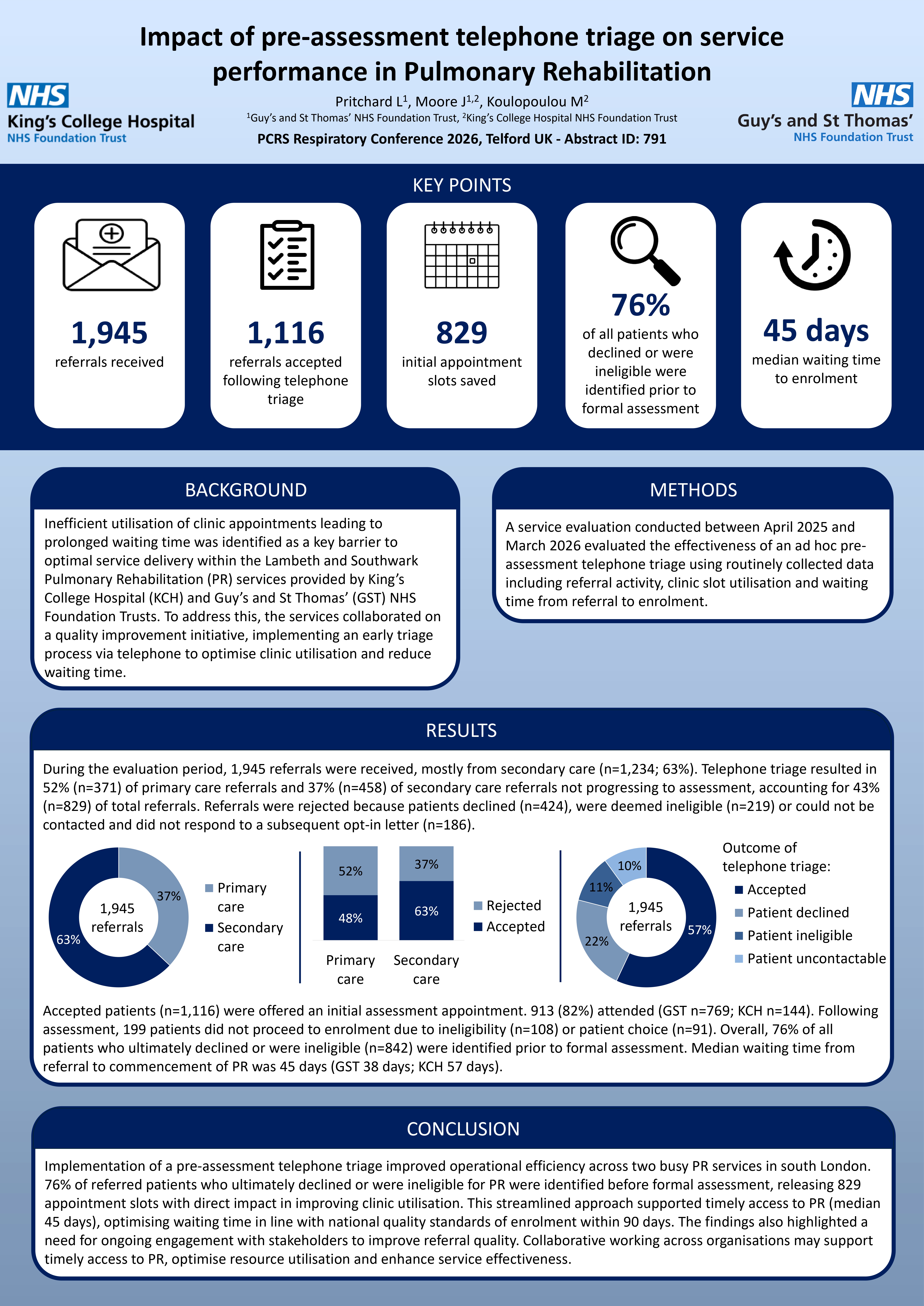
During the evaluation period, 1,945 referrals were received, mostly from secondary care (n=1,234; 63%). Telephone triage resulted in 52% (n=371) of primary care referrals and 37% (n=458) of secondary care referrals not progressing to assessment, accounting for 43% (n=829) of total referrals. Referrals were rejected because patients declined (n=424), were deemed ineligible (n=219) or could not be contacted (n=186).
Accepted patients (n=1,116) were offered an initial assessment appointment with 913 (82%) attending (GST n=769; KCH n=144). Following assessment, 199 patients did not proceed to enrolment due to ineligibility (n=108) or patient choice (n=91). Overall, 76% of all patients who ultimately declined or were ineligible (n=842) were identified prior to formal assessment. Median waiting time from receipt of referral to commencement of PR was 45 days (GST 38 days; KCH 57 days).
Conclusion
Implementation of a pre-assessment telephone triage process improved operational efficiency across two busy PR services in south London. 76% of referred patients who ultimately declined or were ineligible for PR were identified prior to formal assessment, releasing 829 appointment slots with direct impact in improving clinic utilisation. This streamlined approach supported timely access to PR (median 45 days), optimising waiting time in line with national quality standards of enrolment within 90 days. The findings also highlighted a need for ongoing engagement with stakeholders to improve referral quality. Collaborative working across organisations may support more timely access to PR, optimise workforce and clinical resource utilisation and enhance service effectiveness.
Funding: None
Conflicts of interest: None