🏅 Conference Winning Abstract
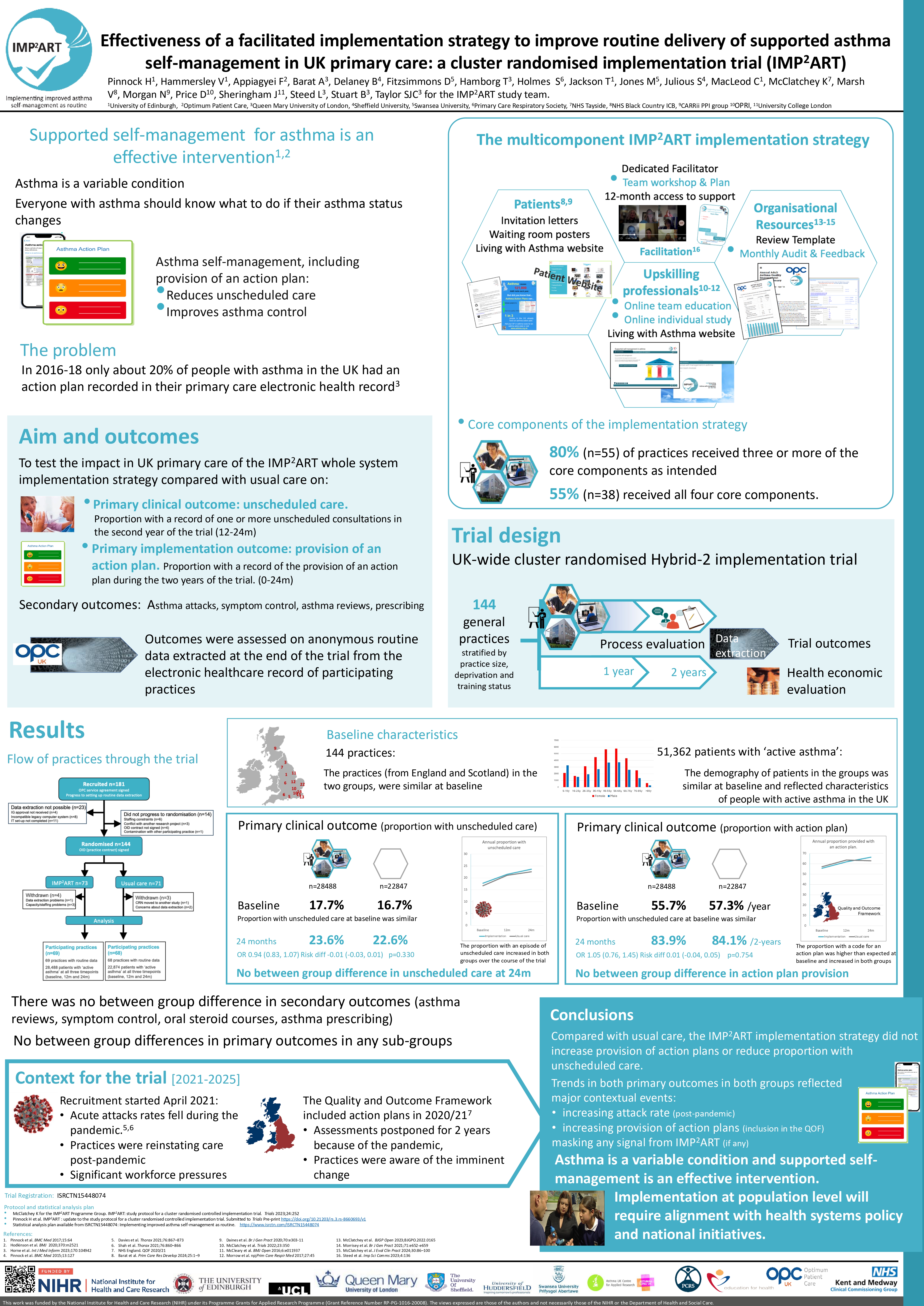
Effectiveness of a facilitated implementation strategy to improve routine delivery of supported asthma self-management in UK primary care: a cluster randomised implementation trial (IMP2ART) (ID 803)
The University of Edinburgh
Abstract
Introduction: Supported self-management for asthma has been recommended for more than three decades, but implementation remains poor.
Aim: To test the effectiveness of facilitated delivery of the IMP2ART implementation strategy (IMP) in UK general practices compared to usual care (UC).
Methods: We recruited general practices in England and Scotland during 2021-23 and randomly allocated practices to receive an implementation strategy (developed with PCRS advisors) or UC. Facilitated by trained specialist nurses, the strategy targeted organisational priorities (audit and feedback, review templates with Optimum-Patient-Care (OPC)), clinicians’ skills (on-line education modules with Education-for-Health) and patient resources (‘Living-with-Asthma’ website). We used routine data (via OPC) to assess between-group difference in proportion with 1 unscheduled asthma care/year (clinical outcome) and proportion given an action plan (implementation outcome) in all patients clinically eligible (age 5-years with ‘active asthma’) at baseline/12m/24m timepoints. Other outcomes included symptom control, asthma care received, and prescribing (reliever medication, oral steroid courses).
Results: We randomised 144 practices (73 IMP, 71 UC: Attrition 4 IMP; 3 UC) and included 28,488 (IMP) and 22,847 (UC) patients in the analysis. Practice and patient baseline characteristics were similar between groups and reflected known UK demographics. Routinely recorded symptom scores indicated 62.6% were well controlled. Overall fidelity to delivery of the strategy was good. In both groups, proportion with 1 unscheduled care increased from an atypically low baseline of 17.3% during the pandemic, but there was no statistically significant between-group difference at 24m (IMP: 23.6% vs UC 22.6%, OR 1.06 (95%CI: 0.93, 1.21) p=0.33). There was no statistically significant between-group difference in proportion given an action plan during the 2-years of the trial (IMP: 84.0% vs UC: 84.1%, OR 1.05 (95%CI: 0.76, 1.45) p=0.75), but reflecting changes to the Quality and Outcome Framework (in England), action plan provision increased in both groups. Similarly, there were no between-group differences in secondary outcomes at 12 or 24-months.
Conclusion: In this low-risk primary care population, we were unable to demonstrate any impact from the IMP2ART strategy. Our experience highlights the crucial role of wider context (COVID-19 pandemic; QOF changes) on patient care and outcomes.
Funding: NIHR RP-PG-1016-20008. ISRCTN 15448074
Funding: The National Institute for Health and Care Research (NIHR) Programme Grants for Applied Research (Reference Number RP-PG-1016-20008). The views expressed are those of the authors and not necessarily those of the NIHR or the Department of Health and Social Care. The funder had no role in the design of this study and will not have any role during its execution, analyses, interpretation of the data, or decision to publish.
Conflicts of interest: The authors declare that they have no competing interests related to supported self-management of asthma. Medicinal products are referred to only by broad therapeutic group (e.g. 'relievers' 'oral corticosteroids') in line with current guideline recommendations. The NIHR grant monies were paid to the authors institutions.