Are Patients with Cluster Headache Prescribed Short-Burst Oxygen Adequately Assessed and Monitored? (ID 804)
Whaddon Medical Centre
Abstract
Background
Cluster headache is a rare but severely disabling primary headache disorder. High-flow oxygen is a first-line treatment for acute attacks. However, patients prescribed short-burst home oxygen therapy (SBOT) have historically not been routinely managed within Home Oxygen Assessment Services (HOAS). Hence, they may not receive standard governance processes, including risk assessment, annual review, Home Oxygen Order Form (HOOF) updates, and monitoring in accordance with British Association for the Study of Headache (BASH) and London Respiratory Network guidance (BASH, 2025; Cohen et al., 2009).
Aim
To evaluate whether patients prescribed SBOT for cluster headache in Milton Keynes were appropriately assessed, monitored and managed in accordance with local and national home oxygen governance standards.
Methods
A retrospective service evaluation identified patients prescribed SBOT for cluster headache between July 2025 and January 2026 using primary care records and home oxygen service databases. Data collected included HOOF documentation, Initial Home Oxygen Risk Mitigation (IHORM) assessments, clinical review, home safety assessments, prescribing practice, oxygen utilisation, and patient safety risk factors.
Results
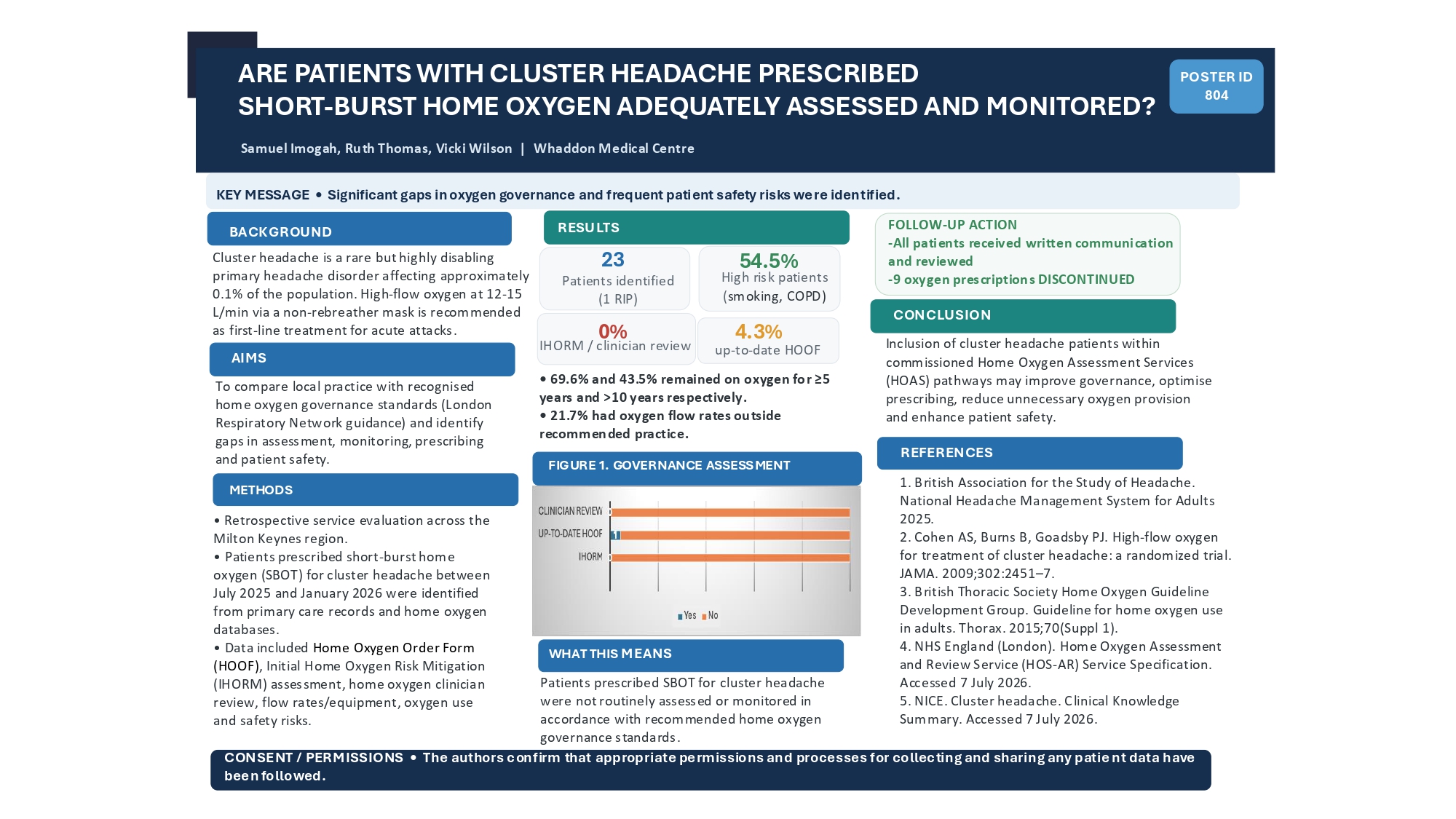
Twenty-three patients were identified in Milton Keynes (mean age 58 years; range 30-82). Although 95.7% received a supplier home safety visit, none had undergone an IHORM assessment or review by a home oxygen clinician. Only one patient (4.3%) had a current HOOF. More than half (54.5%) were identified as high risk due to smoking, respiratory disease, dementia, substance misuse or excessive oxygen use. Nearly 70% had received oxygen for ≥5 years without review and 43.5% for ≥10 years. Only 30.4% were prescribed equipment in accordance with London Respiratory Network guidance, while 21.7% had non-guideline flow rates. Following the evaluation, nine oxygen prescriptions were discontinued, all patients received written communication, and clinical reviews were arranged.
Conclusions
Significant gaps were identified in the governance, assessment and monitoring of patients receiving SBOT for cluster headache. Integrating this patient group into routine HOAS pathways would improve clinical review, risk assessment, prescribing optimisation and patient safety while strengthening home oxygen governance.
References
-BASH (2025). National Headache Management System: Cluster headache. https://bash.org.uk/2-4-1-cluster-headache/
-London Respiratory Network. Home Oxygen Pathway and Cluster Headache Guidance.
Funding: None
Conflicts of interest: None