Embedding meaningful patient and public involvement from application to dissemination: lessons from IMP2ART (ID 810)
University of Edinburgh
Abstract
Background and Aim:
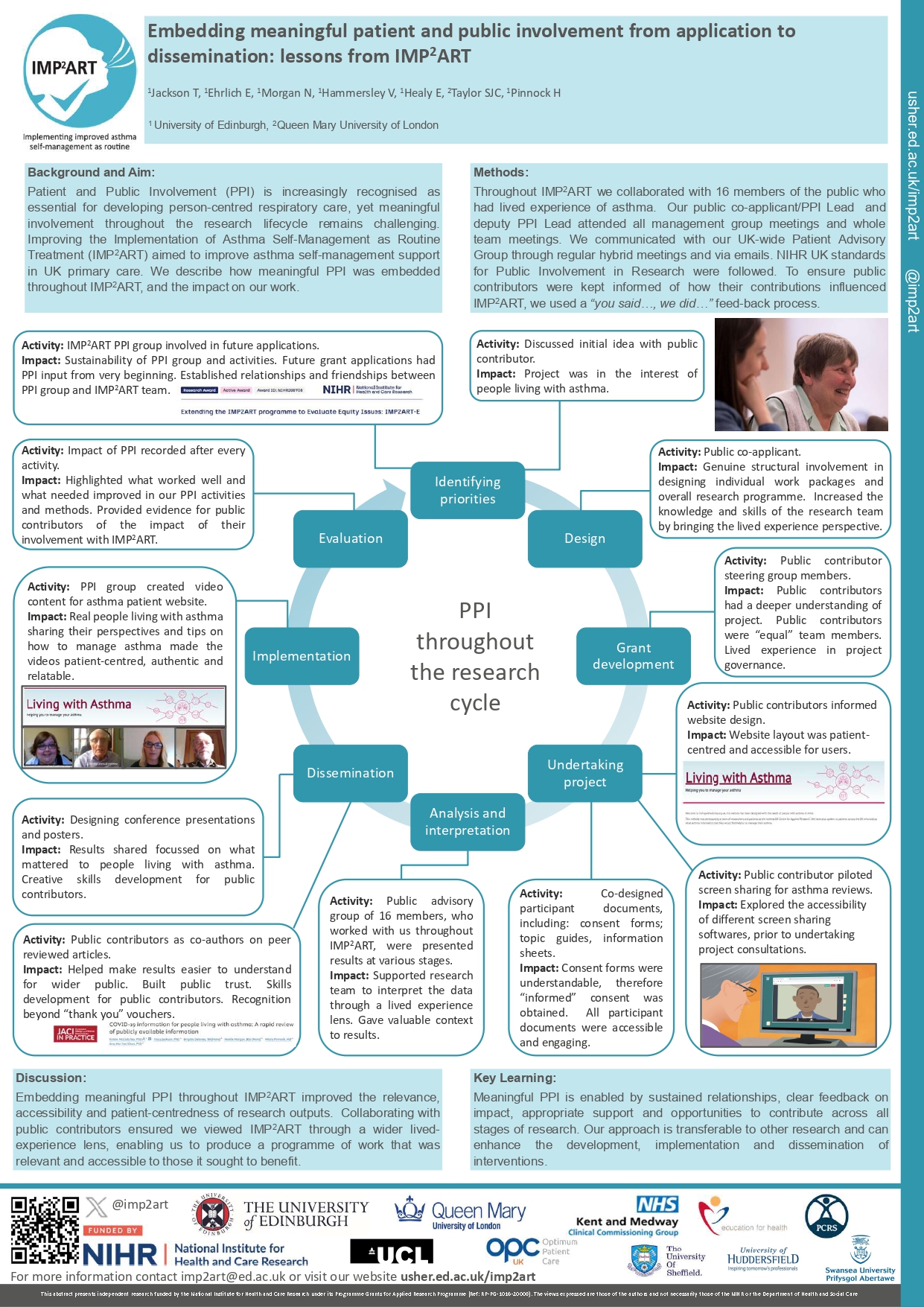
Patient and Public Involvement (PPI) is increasingly recognised as essential for developing person-centred respiratory care, yet meaningful involvement throughout the research lifecycle remains challenging. Improving the Implementation of Asthma Self-Management as Routine Treatment (IMP2ART) aimed to improve asthma self-management support in UK primary care. We describe how meaningful PPI was embedded throughout IMP2ART, and the impact on our work.
Methods:
We followed NIHR UK standards for Public Involvement in research. In addition to a public contributor Lead who was involved as a co-applicant, we had a Patient Advisory Group comprising 16 public contributors (including people living with asthma and carers) who worked with researchers throughout the programme. Public contributors attended regular meetings, co-designed study materials, reviewed questionnaires and interview guides, piloted interviews, contributed to qualitative analysis and interpretation, informed website development, and supported dissemination activities. To ensure public contributors were kept informed of how their contributions influenced IMP2ART, we used a “you said…, we did…” feed-back process.
Results:
Public contributors shaped the design and content of the "Living with Asthma" website, through focus groups (co-led by our public PPI Lead), exploring information needs, asthma reviews, action plans and remote consultations. Contributors co-produced public-facing resources including podcasts, videos and infographics, ensuring accessibility through subtitles, audio content and website accessibility testing. During the process evaluation, public contributors provided insight from their ‘lived experience’ on uptake of resources and the role of families and carers. They were involved in dissemination through conference presentations, stakeholder events, co-authorship on peer-reviewed publications, and supported student and early-career researcher projects.
Discussion:
Embedding meaningful PPI throughout IMP2ART improved the relevance, accessibility and patient-centredness of research outputs. Collaborating with public contributors ensured we viewed IMP2ART through a wider lived-experience lens, enabling us to produce a programme of work that was relevant and accessible to those it sought to benefit.
Key Learning:
Meaningful PPI is enabled by sustained relationships, clear feedback on impact, appropriate support and opportunities to contribute across all stages of research. Our approach is transferable to other research and can enhance the development, implementation and dissemination of interventions.
Funding: NIHR RP-PG-1016-20008.
Conflicts of interest: None