Online Consultations for Asthma Care: Evidence and Practice (ID 811)
The University of Edinburgh
Abstract
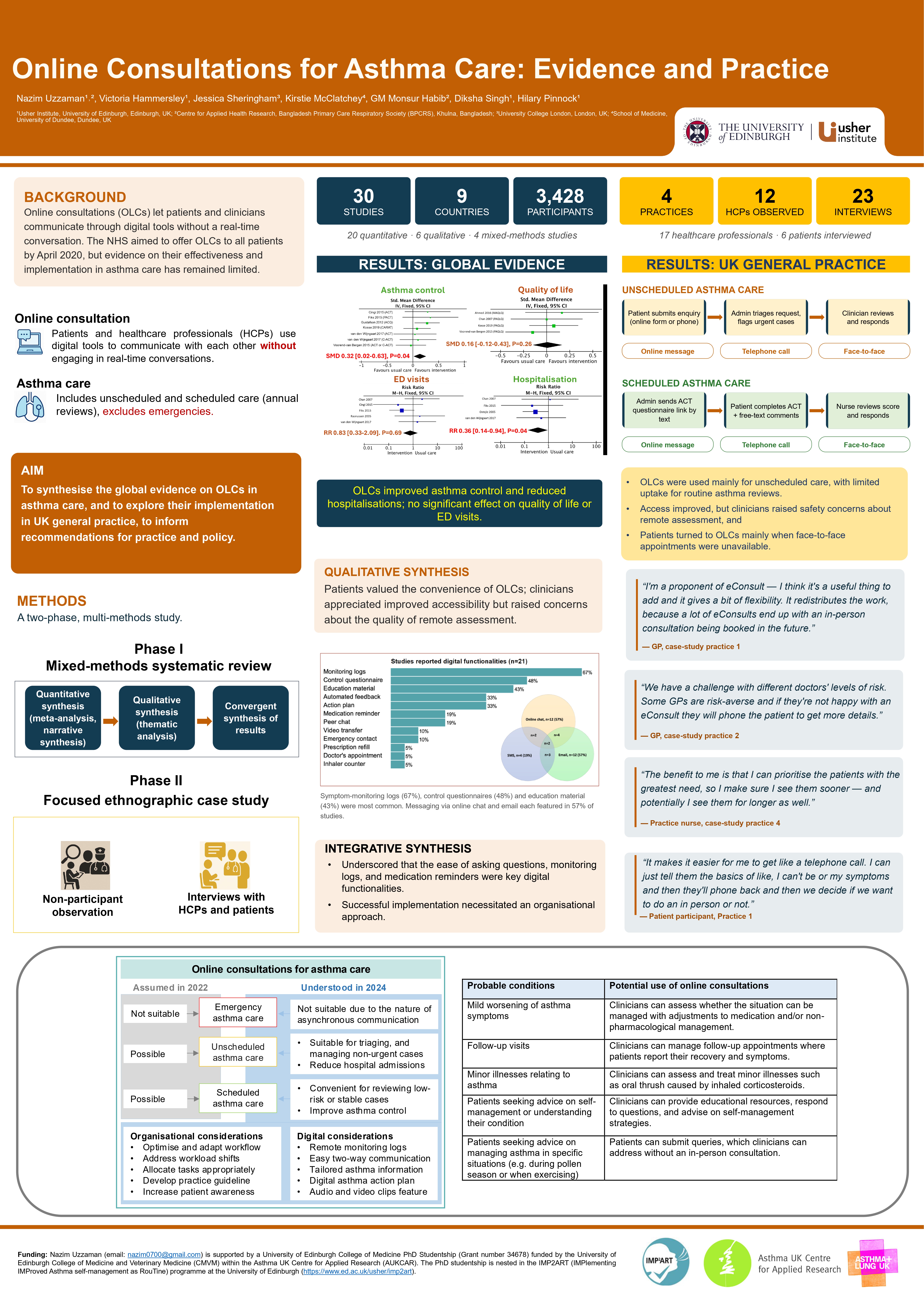
Background and aim: The UK National Health Service aimed to provide online consultations (OLCs) to all patients by April 2020. However, evidence on their effectiveness and implementation in asthma care remains limited. We aimed to synthesise global evidence on OLCs in asthma care and explore their implementation in UK general practice.
Methods: The research comprised two phases. First, we conducted a mixed-methods systematic review of quantitative, qualitative, and mixed-methods studies on OLCs in asthma care. Six databases were searched (2001–2023) following Cochrane methodology and a results-based convergent synthesis design. Meta-analyses and thematic synthesis were undertaken. Second, we conducted a focused ethnographic study in UK general practices. Case study practices were recruited using snowball sampling. Non-participant observations and semi-structured interviews with healthcare professionals and asthma patients were analysed thematically and informed by Normalisation Process Theory (NPT).
Results: Thirty studies from nine countries were included in the review. Interventions including OLCs improved asthma control (SMD 0.32; 95% CI 0.02–0.63; p=0.04) and reduced hospitalisations (RR 0.36; 95% CI 0.14–0.94; p=0.04), with no significant effects on quality of life or emergency visits. Patients valued convenience, though clinicians expressed concerns about remote assessment. Key digital functionalities included symptom monitoring, messaging, and medication reminders.
In the ethnographic study, we observed 12 healthcare professionals and interviewed 17 staff and six patients across four practices. OLCs were used mainly for unscheduled care, with limited use for routine asthma reviews. Although OLCs improved access, clinicians raised safety concerns, and patients primarily used them when face-to-face appointments were unavailable. NPT analysis highlighted the importance of clear task allocation, workflow integration, and staff engagement.
A presentation at PCRS 2024 enabled feedback which supported interpretation and informed conclusions and recommendations.
Conclusion: OLCs can improve asthma outcomes and provide a convenient option for non-emergency asthma care. However, successful implementation requires integration into practice workflows, staff engagement, and adaptation to local needs.
Funding: Asthma and Lung UK PhD Scholarship
Conflicts of interest: None