How engagement in pulmonary rehabilitation is affected by the addition of a social prescribing link worker to the multi-disciplinary team. (ID 813)
Guys and St Thomas Trust
Abstract
Background: Despite pulmonary rehabilitation’s (PR) strong evidence base, uptake and completion is sub-optimal and is disproportionately poor in populations with higher rates of social deprivation.
Aim: This quality improvement project aimed to evaluate whether embedding a social prescribing link worker (SPLW) in the PR team improved uptake and completion of PR for patients in a hospital in South-East London.
Methods: Referrals were received from respiratory clinicians for eligible patients identified as having unmet social needs. All patients triaged for PR were offered support from the SPLW allowing them to opt in. Patients were seen face-to-face, via telephone or at home. The SPLW offered tailored input addressing the social determinants of health.
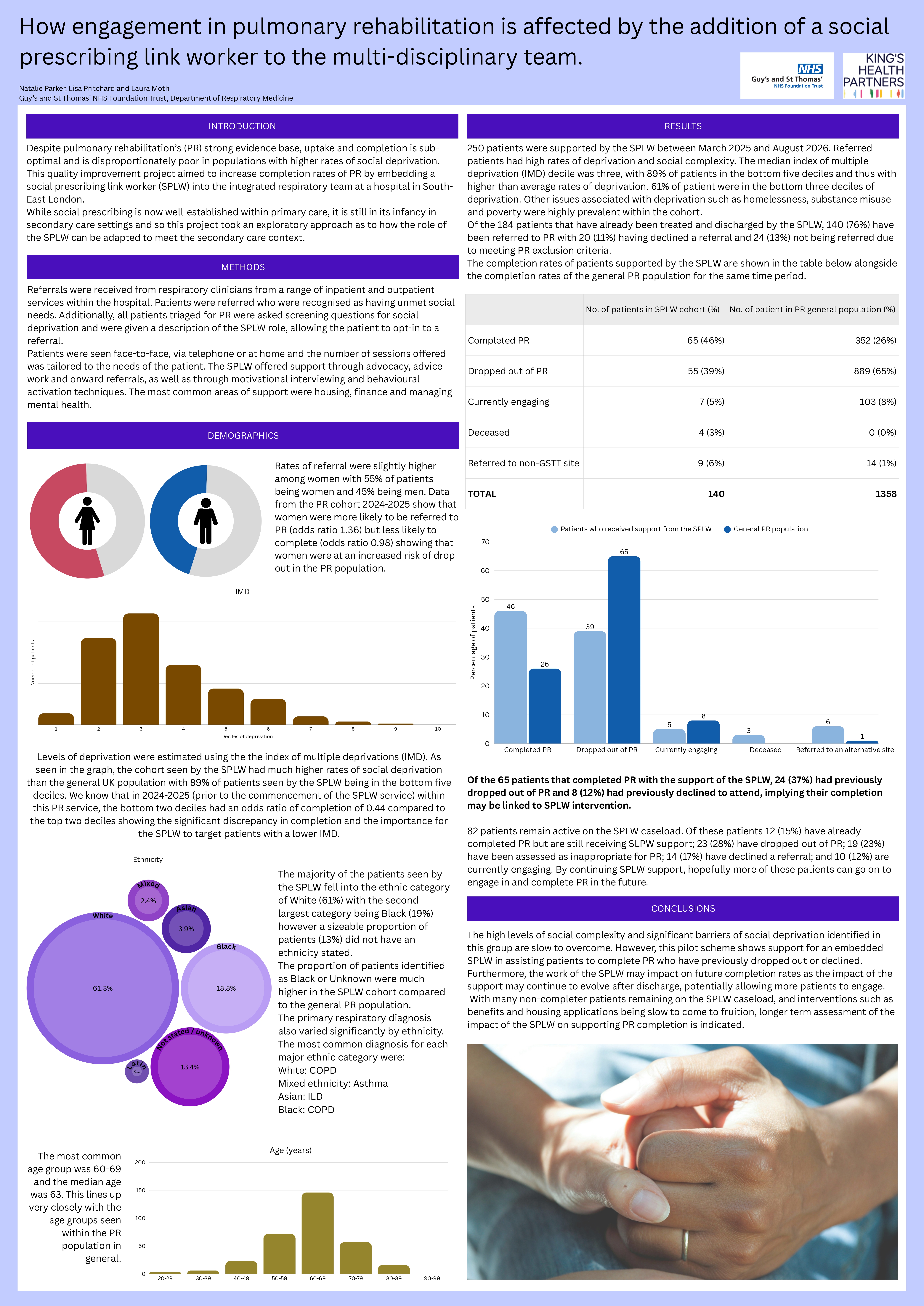
Results: 218 patients were seen between March 2025 and June 2026 (median age 63; 53% female; 60% white; 40% global majority; 67% COPD diagnosis). Referred patients had high rates of deprivation and social complexity. The median index of multiple deprivation decile was three with 89% of patients in the bottom five deciles and 61% in the bottom three.
159 patients were supported to enrol in PR with the remaining patients deemed not appropriate (n=39), declined (n=17), or deceased (n=3).
Table 1 shows enrolled patient outcomes. Of the 63 patients that completed PR with the support of the SPLW, 22 (35%) had previously dropped out of PR and 7 (11%) had previously declined to attend.
104 patients remain active on the SPLW caseload, 49 of whom are not currently engaging in PR but may be able to in the future (dropped out n=35, declined n=14).
Conclusions: The high levels of social complexity and significant barriers of social deprivation identified in this group are slow to overcome. However, this pilot scheme shows support for an embedded SPLW in assisting patients to complete PR who have previously dropped out or declined. Furthermore, the work of the SPLW may impact on future completion rates. With many non-completer patients remaining on the SPLW caseload, and interventions such as benefits and housing applications being slow to come to fruition, longer term assessment of the impact of the SPLW on supporting PR completion is indicated.
Funding: No direct research funding was received, funds came under service funding from King's Health Partner's Mind and Body team.
Conflicts of interest: None