Moderate and Severe COPD Exacerbations Lead to Sustained Impairment in Health-related Quality of Life (ID 815)
GSK
Abstract
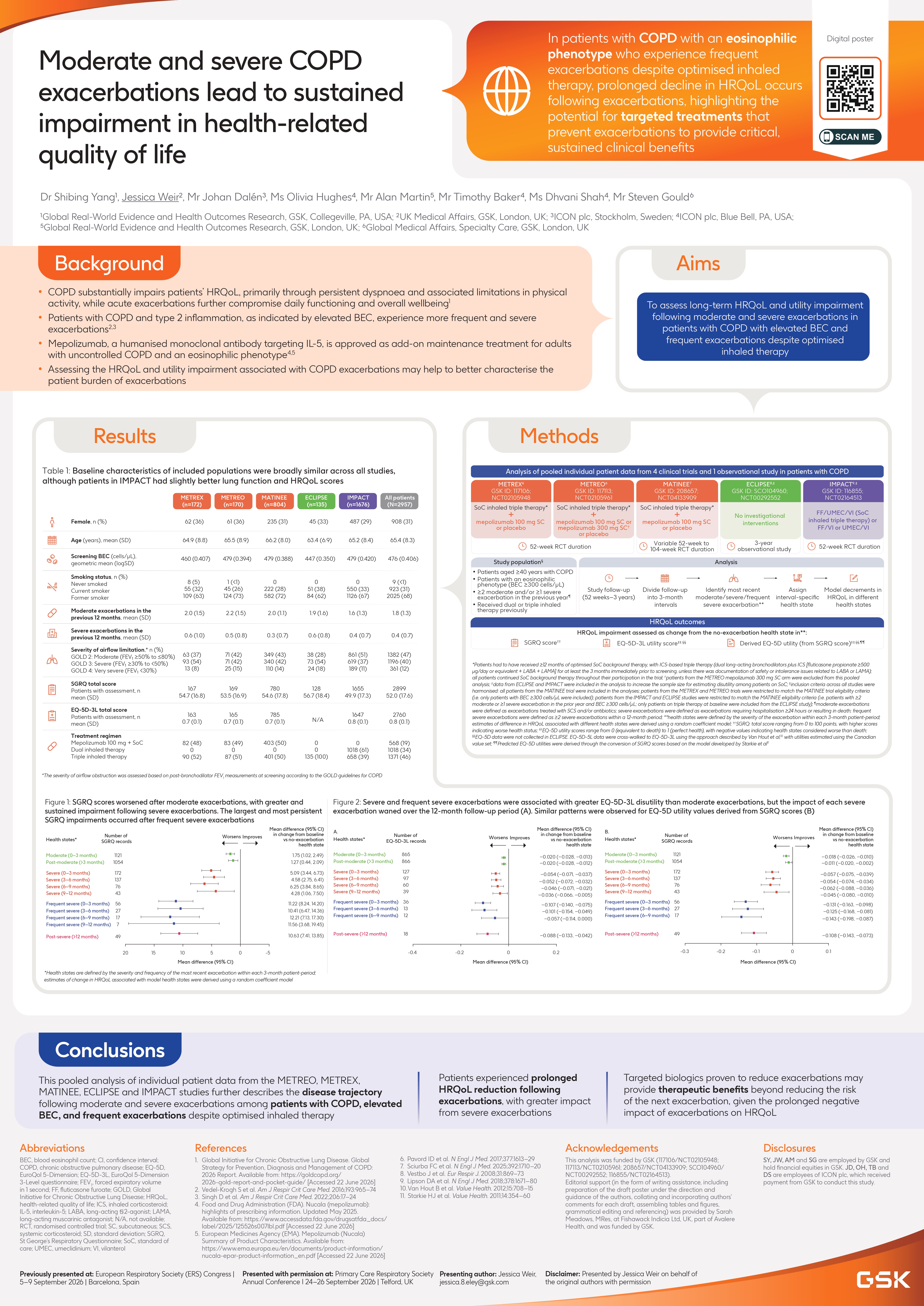
Background: COPD reduces health-related quality of life (HRQoL) through persistent breathlessness and activity limitation, with exacerbations causing further impairment.
Aims: To assess long-term HRQoL and utility impairment following moderate and severe exacerbations in patients with COPD with raised blood eosinophil count (BEC) and frequent exacerbations despite optimised inhaled therapy.
Methods: Individual patient data from 4 clinical trials and 1 observational study in COPD were pooled (Table); inclusion criteria were harmonised (BEC ≥300 cells/μL, ≥2 moderate or ≥1 severe exacerbation in the prior year on dual or triple inhaled therapy). Study periods (ranging from 52 weeks to 3 years) were split into 3-month intervals, each patient interval assigned a health state based on time since last moderate, severe, or frequent severe exacerbation (Table). HRQoL impairment versus no-exacerbation was estimated by St George’s Respiratory Questionnaire (SGRQ) scores, and utility impairment using EuroQoL 5-Dimension 3-Level (EQ-5D-3L) and EQ-5D derived from SGRQ.
Results: SGRQ worsened after moderate exacerbations, with greater and sustained impairment following severe events; the largest and most persistent increases occurred after frequent severe exacerbations. Similar patterns were observed for EQ-5D utilities (Table).
Conclusions: Patients with COPD with raised BEC experience prolonged HRQoL reduction following exacerbations, with greater impact from severe exacerbations.
Funding: GSK (218965).
Previously presented at ERS2026.
Funding: This study was funded by GSK.
Conflicts of interest: JW, SY, AM and SG are employees of GSK and hold financial equities in GSK. JD, OH, TB and DS are employees of ICON plc, which received payment from GSK to conduct this study.