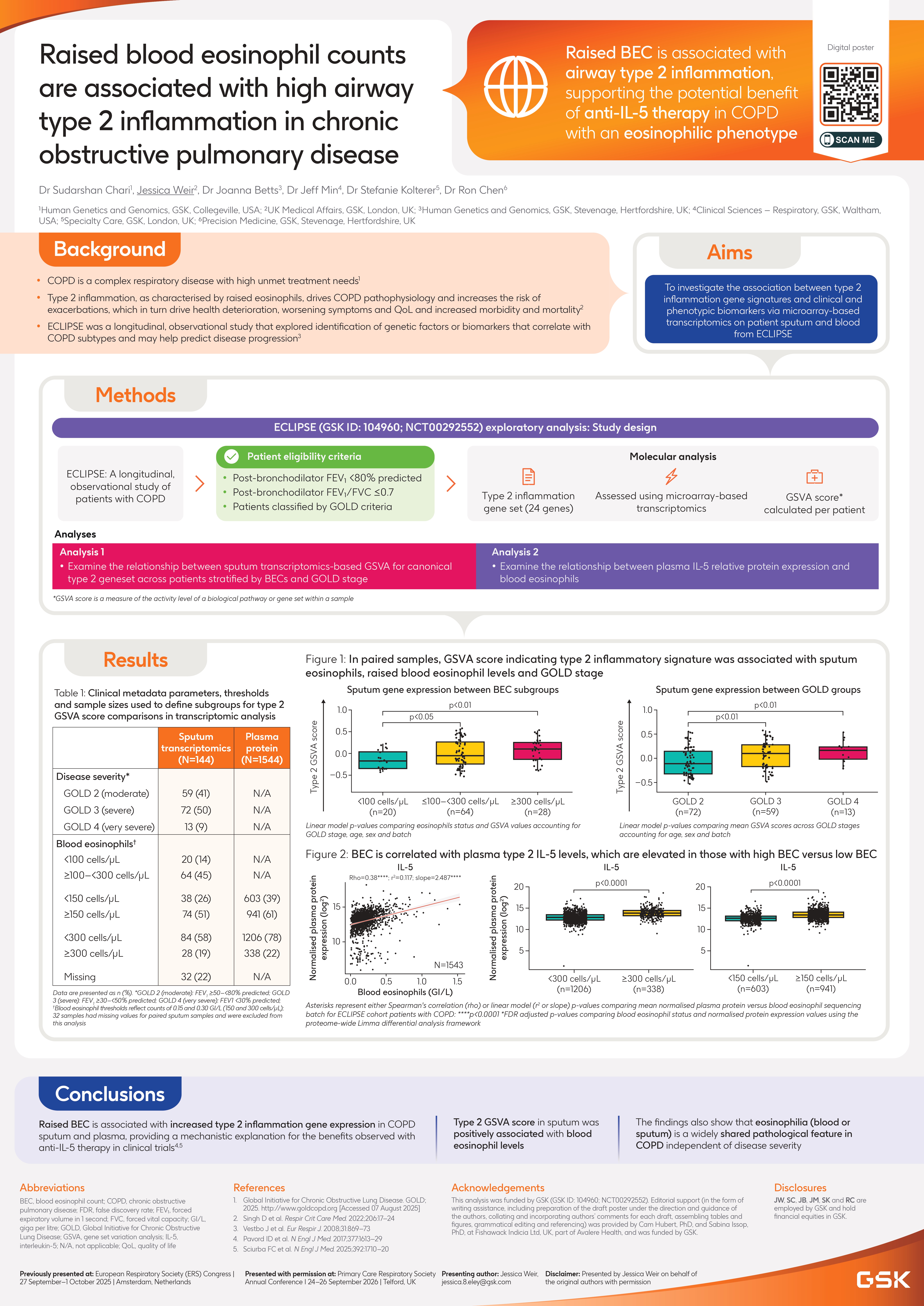
Raised Blood Eosinophil Counts are Associated with High Airway Type 2 Inflammation in Chronic Obstructive Pulmonary Disease (ID 820)
GSK
Abstract
Background: Type 2 inflammation and eosinophils can promote chronic obstructive pulmonary disease (COPD) pathophysiology and increase the risk of exacerbations.
Aims: To assess the association between type 2 inflammation gene signatures and clinical and phenotypic biomarkers.
Methods: ECLIPSE (NCT00292552) was a longitudinal, observational study of patients with COPD, a baseline post-bronchodilator (BD) forced expiratory volume in 1 second (FEV1) <80% predicted, and baseline post-BD FEV1/forced vital capacity ≤0.7. A type 2 gene set signature (24 genes) was assessed by microarray-based transcriptomics. Gene set variation analysis (GSVA) scores for the gene set signature in each patient were calculated. Analysis 1 assessed GSVA score association with sputum and blood eosinophil count (BEC) using Spearman’s correlation and linear models. Analysis 2 assessed sputum GSVA score association with sputum eosinophil count.
Results: Analysis 1 included 112 samples with paired sputum and BEC. Type 2 GSVA score was associated with sputum eosinophils (≥2% or <2%) and with BEC distribution subgroups (<100, 100–299, and ≥300 cells/μL). Analysis 2 included 143 sputum samples. Type 2 GSVA score in sputum cell gene expression activities was positively associated with both BEC levels and sputum eosinophil counts. These positive associations persisted when GOLD E patients were excluded.
Conclusions: Raised BEC is associated with increased type 2 inflammation gene expression in COPD sputum, suggesting anti-interleukin-5 therapy may reduce exacerbations. The findings also suggest a widely shared pathological feature in COPD, regardless of GOLD grade.
Funding: GSK (104960).
Previously presented at ERS 2025.
Funding: This study was funded by GSK.
Conflicts of interest: JW, SC, JB, JM, SK and RC are employees of GSK and hold financial equities in GSK.