Warm Homes, Better Breathing: A Neighbourhood Approach to Supporting Respiratory Patients Affected by Fuel Poverty (ID 824)
The Innovation Agency (Academic Health Science Network for the North West Coast)
Abstract
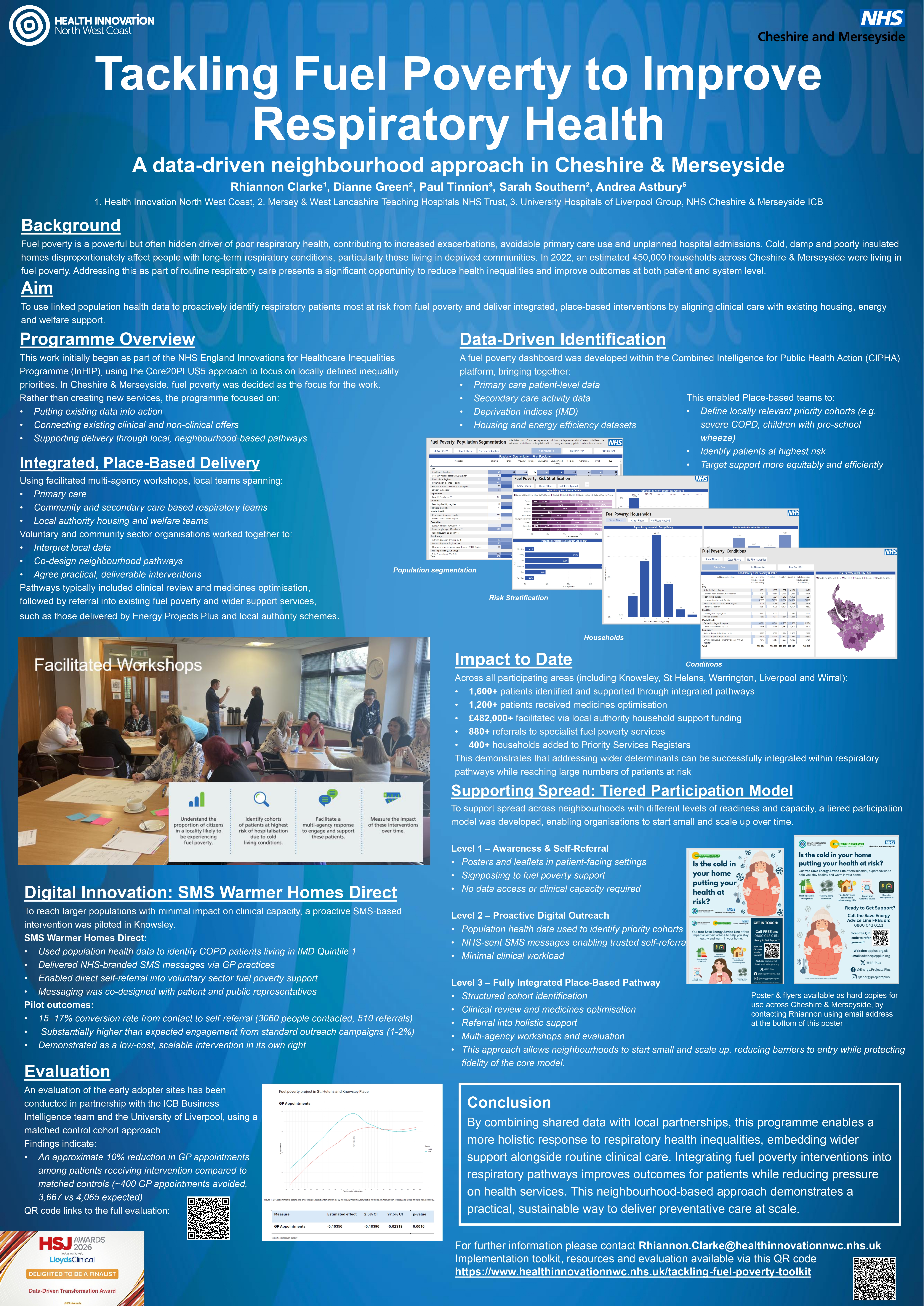
Fuel poverty is a significant driver of poor outcomes for people with respiratory conditions, contributing to exacerbations, increased healthcare utilisation and widening health inequalities, particularly in deprived communities across Cheshire & Merseyside. Building on earlier pilot work, this programme reflects progression to larger-scale implementation and evaluation across adult and children’s pathways.
Analysis of local population health data identified an opportunity to intervene earlier. Using the Combined Intelligence for Public Health Action (CIPHA) platform, patients at highest risk were identified by linking primary care, secondary care, deprivation and housing data.
The strategy for change focused on integrating existing services rather than creating new ones. Multi-agency workshops brought together primary care, community and secondary care based respiratory teams, local authorities and voluntary sector partners to co-design neighbourhood pathways for priority cohorts, including people with severe COPD and children with pre-school wheeze. These pathways combined clinical review, medicines optimisation where appropriate, and referral into fuel poverty and wider support services.
To extend reach, a digital intervention (“SMS Warmer Homes Direct”) used GP text messaging to proactively connect COPD patients in deprived communities to support.
A tiered participation model was developed to enable scalable adoption across neighbourhoods with different capacity. Level 1 focuses on awareness and access, using posters, leaflets and QR-coded materials in primary care and community settings to enable self-referral into support services. Level 2 introduces proactive digital outreach using population health data and SMS to directly engage high-risk patients. Level 3 delivers fully integrated care, combining data-led cohort identification, clinical review and referral into coordinated support pathways.
Across participating areas, over 1,600 patients were supported, with more than 1,200 receiving medicines optimisation and over £482,000 in household support facilitated. Evaluation using the Real world Intervention Causal Evaluation (RICE) tool demonstrated an approximate 10% reduction in GP appointments in the 12 months following intervention, compared with a matched control cohort.
Key lessons include the importance of combining data-driven identification with strong local partnerships and providing flexible entry points to support adoption. This approach offers a scalable neighbourhood model for integrating respiratory care with wider determinants to improve outcomes and reduce inequalities.
Funding: This project initially received £100,000 funding through the NHS England Innovations for Healthcare Inequalities Programme (InHIP). Delivery has since focused on aligning and using existing system resources and services.
Conflicts of interest: None