Asthma and COPD Winter Burden Study: Assessment of the winter burden of asthma and COPD after treatment review. (ID 831)
AstraZeneca
Abstract
Background:
Asthma and chronic obstructive pulmonary disease (COPD) are associated with substantial winter morbidity. Using UK electronic healthcare records, we evaluated the relationship between disease control, treatment review and winter exacerbations, and assessed whether pre-winter review with treatment escalation of uncontrolled patients reduces exacerbation burden.
Methods:
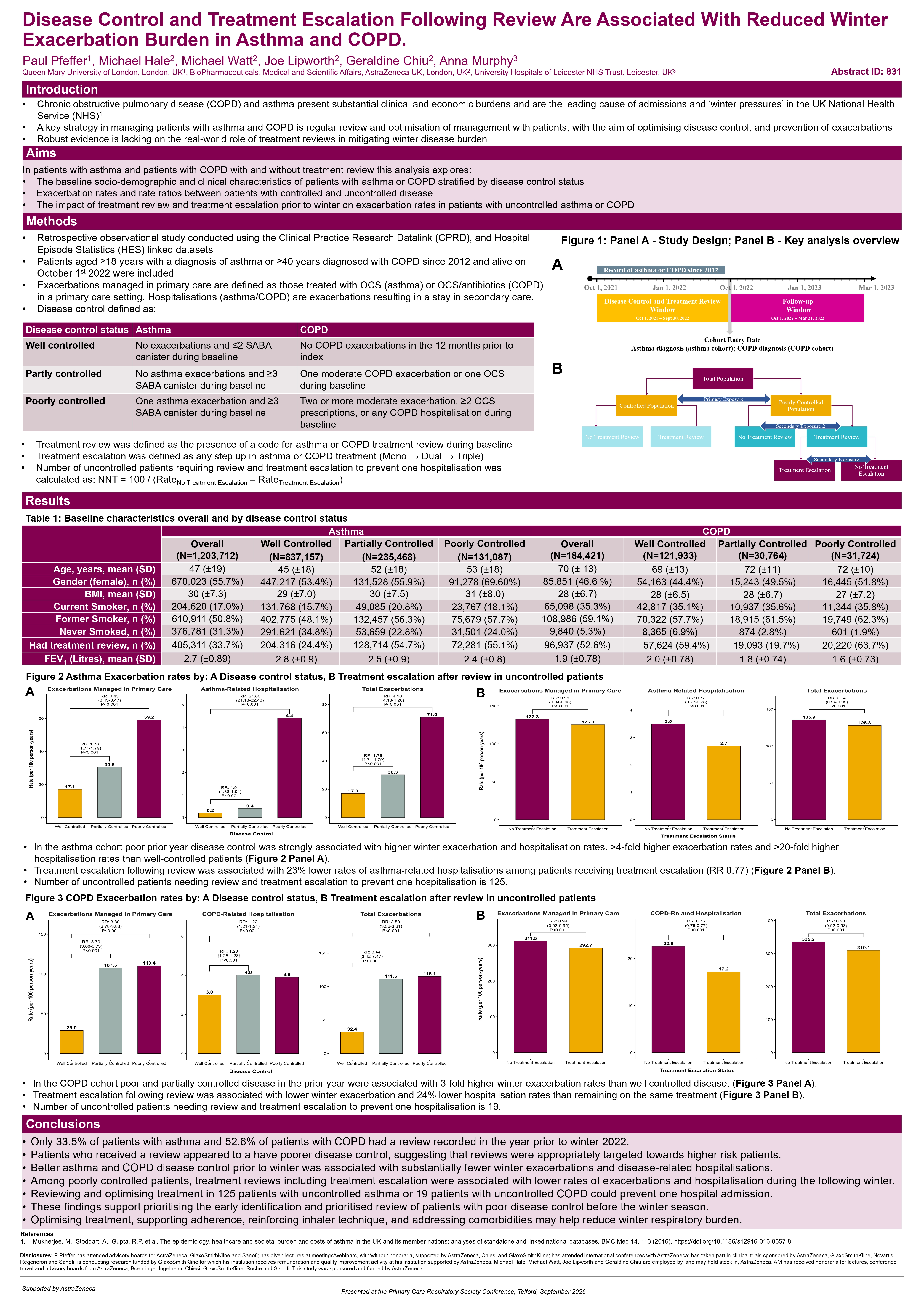
This retrospective cohort study used primary (CPRD) and secondary care (HES) data to identify adults with asthma aged ≥18 years or COPD aged ≥40 years alive at index (1/10/2022) with ≥12 months of prior data. Disease control, exacerbations and OCS usage, were assessed in the year prior to index. Uncontrolled patients had ≥1 exacerbation (asthma) or 2 moderate or 1 severe (COPD) in the year prior to index. Partially controlled patients had no exacerbations but ≥3 SABA canisters (asthma) or 1 moderate COPD exacerbation (COPD) in the year prior to index. Patients were followed from 01/10/2022-31/03/2023 to assess exacerbations. Secondary analyses evaluated the impact of treatment reviews, and treatment escalation in uncontrolled patients.
Results:
In both diseases, patients who were controlled at index had fewer exacerbations over the following winter. In asthma (N=1,203,712), uncontrolled patients experienced a four-fold increase in exacerbations (Rate Ratio (RR): 4.18; 95%CI [4.15–4.20]) compared to controlled patients, and a higher burden of asthma-related hospitalisations (21.80; [21.13–22.48]). Similarly in COPD (N=184,421), uncontrolled patients experienced approximately four times more exacerbations (4.41; [4.38-4.43]), with a twenty percent increase in COPD-related hospitalisations (1.22; [1.21–1.24]) (Figure 1).
Treatment review alone was not associated with winter exacerbations. However, among uncontrolled patients with asthma review with treatment escalation was associated with a 6% reduction in exacerbations (0.94; [0.94–0.95]) and a 23% reduction in asthma-related hospitalisations (0.77; [0.77–0.78]) versus reviewed patients with no escalation. In COPD, escalation following review was associated with similar reductions, with COPD-related hospitalisations reduced by approximately 15% (0.85; [0.84–0.86]) (Figure 2).
Conclusions:
Disease control before winter is strongly associated with exacerbation burden in asthma and COPD, particularly hospitalisations. Proactive treatment reviews, prioritising uncontrolled patients to optimise guideline directed medical therapy offer an opportunity to prevent winter exacerbations and reduce NHS winter pressures.
Funding: This study was sponsored and funded by AstraZeneca.
Conflicts of interest: Paul Pfeffer has attended advisory boards for AstraZeneca, GlaxoSmithKline and Sanofi; has given lectures at meetings/webinars, with/without honoraria, supported by AstraZeneca, Chiesi and GlaxoSmithKline; has attended international conferences with AstraZeneca; has taken part in clinical trials sponsored by AstraZeneca, GlaxoSmithKline, Novartis, Regeneron and Sanofi; is conducting research funded by GlaxoSmithKline for which his institution receives remuneration and quality improvement activity at his institution supported by AstraZeneca. Michael Hale, Michael Watt, Geraldine Chiu and Joe Lipworth are employed by, and may hold stock in, AstraZeneca. Anna Murphy has received honoraria for lectures, conference travel and advisory boards from AstraZeneca, Boehringer Ingelheim, Chiesi, GlaxoSmithKline, Roche and Sanofi.