The inherent variability of asthma: implications for diagnosis and assessing response to treatment (ID 833)
University of Manchester, Division of Infection, Immunity and Respiratory Medicine, Manchester University NHS Foundation Trust, Department of Allergy & Respiratory Medicine
Abstract
Background: Asthma diagnostic guidelines emphasise the importance of objective testing. With limited access to objective testing, many clinicians utilise clinical response to treatment for diagnosis. Asthma is characterised by temporal variability and symptoms may improve without treatment. We assess temporal variability in symptoms, lung function and airway inflammation at the diagnostic setting.
Methods: Participants aged 3-69 yrs with asthma symptoms and no recent inhaled corticosteroids were referred from primary care to the Rapid Access Diagnostics in Asthma (RADIcA) study. All participants completed baseline assessments at two time-points (visit 1, V1 and visit 2, V2) without change in treatment and 2-6 weeks apart, including: Asthma Control Questionnaire (ACQ), FeNO and spirometry (forced exhaled volume in 1 sec (FEV1)). Between-visit variability was assessed by determining the proportion of participants demonstrating the minimal clinically important difference (MCID) between visits.
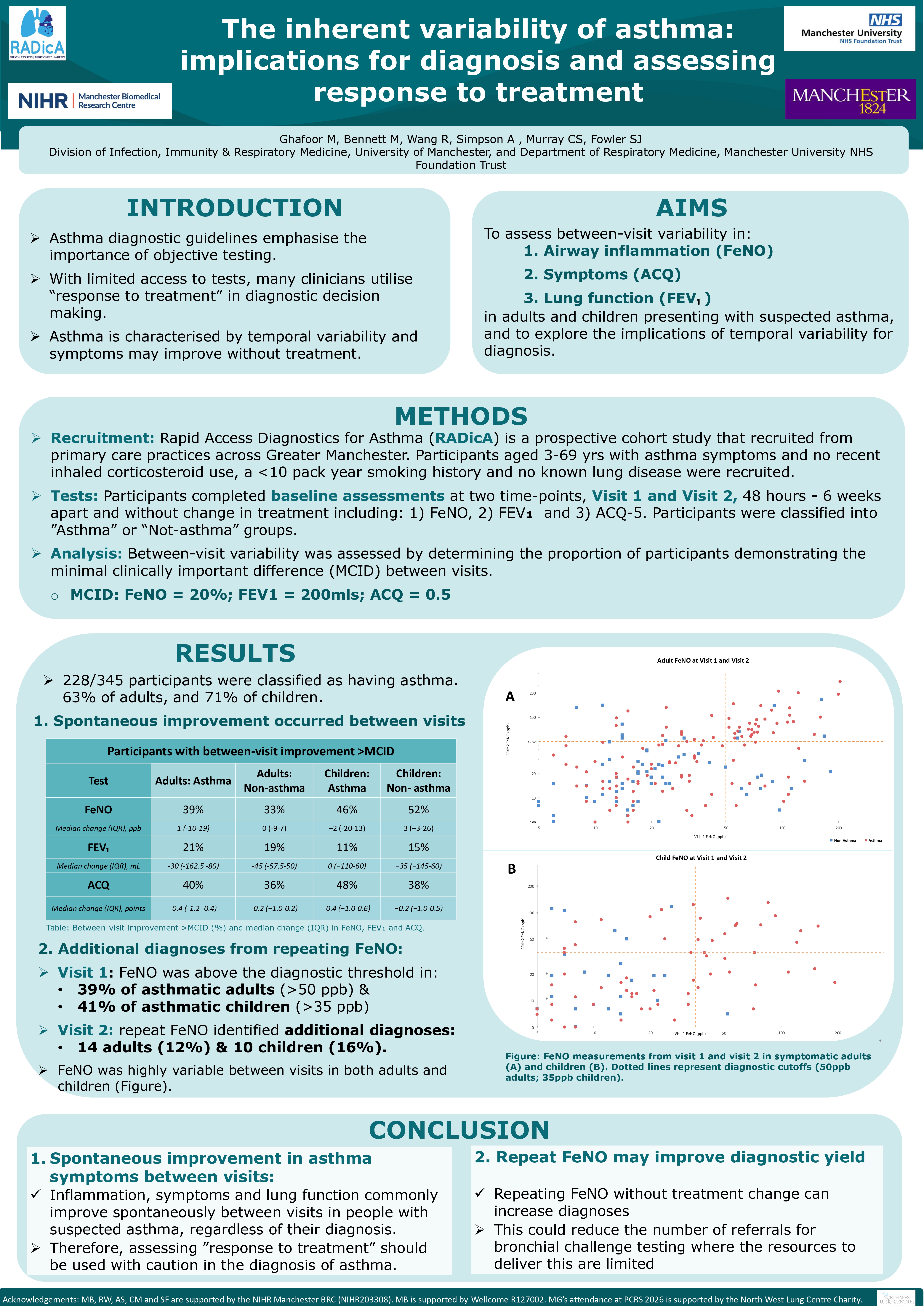
Results: Of 345 symptomatic participants completing both visits, 228 were diagnosed with asthma (63% of adults, 71% of children; table).
1. Spontaneous improvement between visits: For adults there was a between-visit improvement >MCID for FeNO (20%), FEV1 (200mls) and ACQ (0.5) in asthma 39%, 21% and 40% respectively, and in non-asthma in 33%, 19% and 36%.
For children with asthma there was an improvement in 46%, 11% and 48% respectively, and without asthma in 52%, 15%, and 38%.
2. Additional diagnoses from repeating FeNO: V1 FeNO was above the diagnostic threshold in 39% asthmatic adults (>50ppb) and 41% asthmatic children (>35ppb). FeNO was highly variable between visits (figure). Repeat FeNO testing at V2 identified an additional 14 (12%) asthmatic adults and 10 (16%) asthmatic children.
Conclusions: 1. Spontaneous improvement in inflammation, symptoms and lung function occurs commonly in people presenting with symptoms of asthma, regardless of their ultimate diagnosis. An assessment of “response to treatment” is therefore not helpful in making an asthma diagnosis. 2. Where spirometry is not readily available then repeating FeNO without treatment change can increase the number of patients diagnosed with asthma and therefore reduce the number requiring referral.
Funding: MB, RW, AS, CM and SJF are supported by the Manchester NIHR Biomedical Research Centre (BRC) (NIHR203308), MB is also supported by Wellcome (223521/Z/21/Z). RW is supported by NIHR Clinical Lectureship.
Conflicts of interest: None.