Offering home sensors to families of children with high-risk respiratory conditions: a feasibility study to connect NHS and housing pathways (ID 836)
University College London (UCL)
Abstract
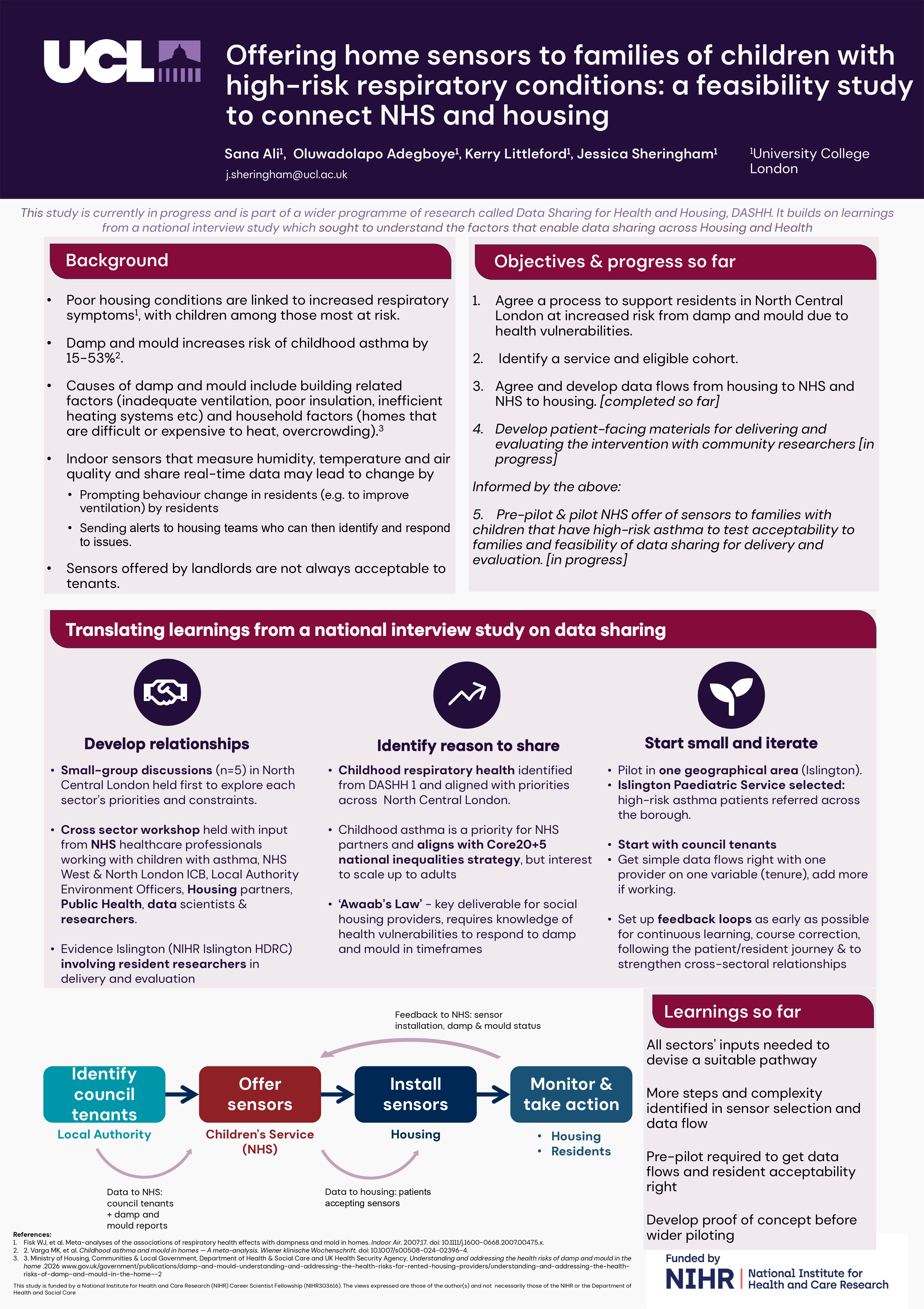
Background: Poor housing conditions, e.g. damp and mould, increase childhood respiratory symptoms by 30–50%. Both housing providers and NHS professionals are concerned about these impacts but knowledge of each’s other’s sectors hinders opportunities to integrate care. Many social housing providers are exploring indoor home sensors that can track humidity, temperature and air quality to expedite identification and response to damp and mould. Resident uptake, however, is variable in part due to concerns about privacy and uncertainties about benefits. Offering sensors through NHS pathways may improve acceptability particularly among vulnerable households with children at high risk of respiratory conditions.
Objective: To develop a feasible and acceptable pathway to offer home sensors through an NHS service to the families of children with high-risk asthma living in social housing.
Methods: One-to-one meetings and multi-agency stakeholder workshops across North Central and West London were convened to understand current care pathways for children with high-risk respiratory conditions, map processes for offering sensors and design supporting data flows. Stakeholders comprised healthcare professionals in primary and secondary care, local authority environmental/pollution officers, housing managers, public health professionals, researchers and data scientists and Integrated Care Board (ICB) staff. Resident engagement was conducted separately.
Learning so far: Across stakeholders, childhood respiratory health was widely recognised as a shared priority. The Paediatric Primary Care Service emerged as the most appropriate setting to offer sensors. The Service, which receives referrals from general practices children with for high-risk respiratory conditions, provides a single point of contact and sufficient consultation times to discuss housing problems affecting health. However, initial stages of pathway design revealed multiple interconnected components, highlighting greater complexity than initially anticipated. As a result, we have changed the approach from piloting and evaluation to an iterative co-development process with a small group of residents.
Next steps: A pathway within Islington will be co-developed with residents, health professionals, housing officers and researchers. Initial focus will be on optimising acceptability and feasibility, with the aim of informing potential scale-up across the ICB and wider regions
Funding: NIHR Population Health Career Scientist Award (Ref: NIHR303616).
Conflicts of interest: None