Optimising opportunities for capacity building within programme grants: the example of the IMP2ART programme (ID 837)
The University of Edinburgh
Abstract
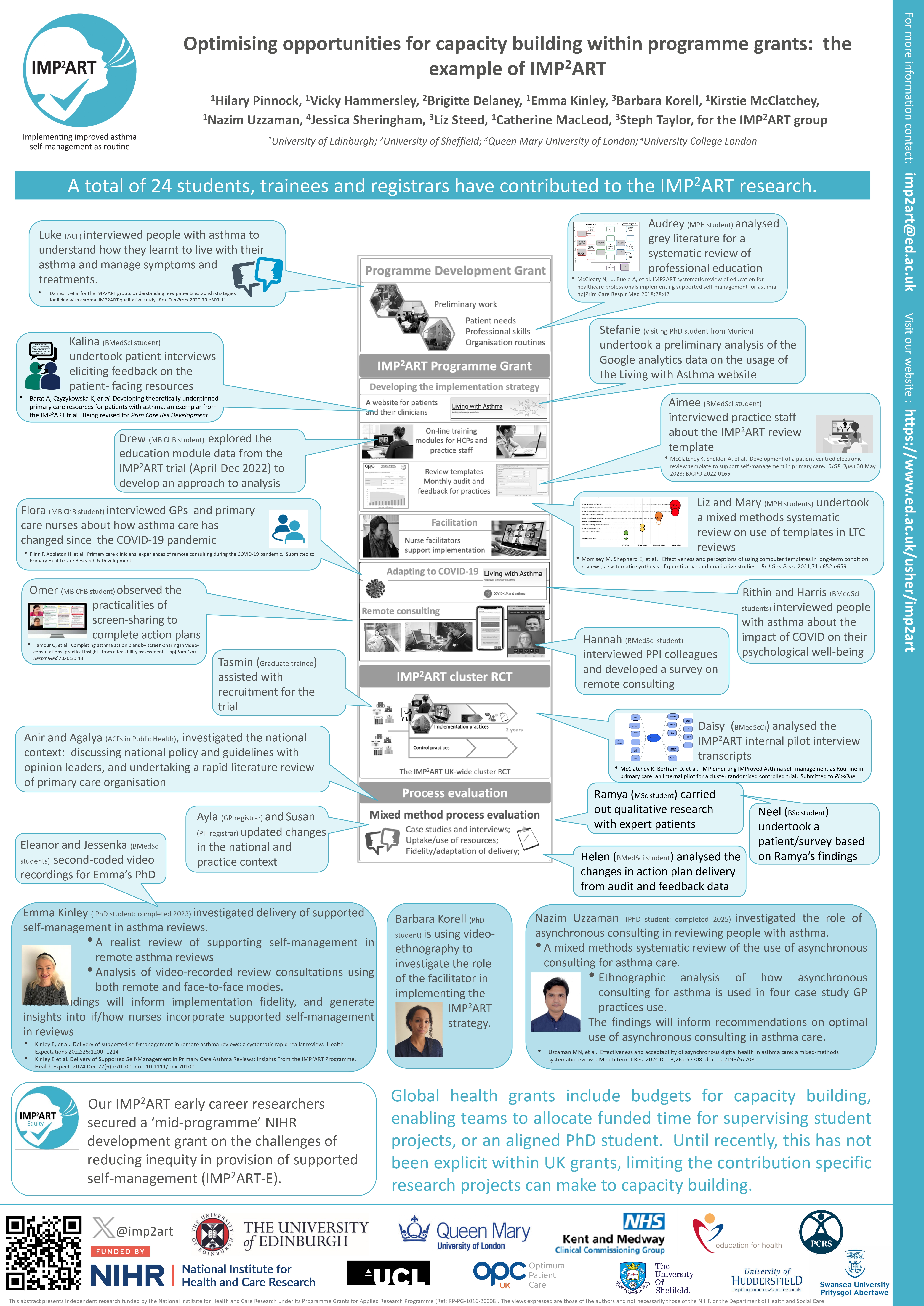
Background and aim: Exposure to research for under/post-graduates is particulary important in disciplines such as primary care where academics are under-represented. We aimed to optimise the opportunities offered by an NIHR Programme Grant to involve students and build interest and capacity in applied health service research in primary care.
Methods: We secured funding for aligned PhD studentships and engaged with opportunities to host undergraduate and Masters students. Students were encouraged to be part of the IMP2ART team during their attachment, joining team meetings, engaging with Patient and Public Involvement colleagues and contributing their project findings to the programme.
Results: During the 6-year IMP2ART programme, a total of 24 students/trainees/registrars have been involved with, and contributed to the developmental work, process evaluation data and qualitative research. This included sixteen undergraduates (BMedSci/BSc/medical students), two MPH students, one Masters student, two Academic Clinical Fellows, one Public Health Registrar, one GP registrar and an international visiting PhD student. They have presented eight abstracts (four at international conferences) and contributed to eight papers (three as first authors).
In addition, three PhD students (funded by CSO/THIS/UoE) have explored supporting self-management in remote reviews, the role of facilitation, and asynchronous consulting, two have successfully defended their theses. They have presented 21 abstracts and published four first author papers.
We also supported IMP2ART early career researchers to secure a ‘mid-programme’ development grant on the challenges of reducing inequity in provision of supported self-management (IMP2ART-E).
Conclusion: Global health grants typically include a budget for capacity building, enabling teams to allocate funded time for supervising student projects, developing on-line training, or supervising an aligned PhD student. This has rarely been explicit within UK grants, limiting the contribution specific research projects can make to capacity building. We welcome the recent changes towards an approach that embraces capacity building as the norm within research.
Funding: NIHR PGfAR (RP-PG-1016-20008).
Conflicts of interest: None