Transforming Asthma Management in Primary Care: A Pharmacist-Led Asthma Education and Medicines Optimisation Programme (ID 839)
Nuneaton and Bedworth Primary Care Network
Abstract
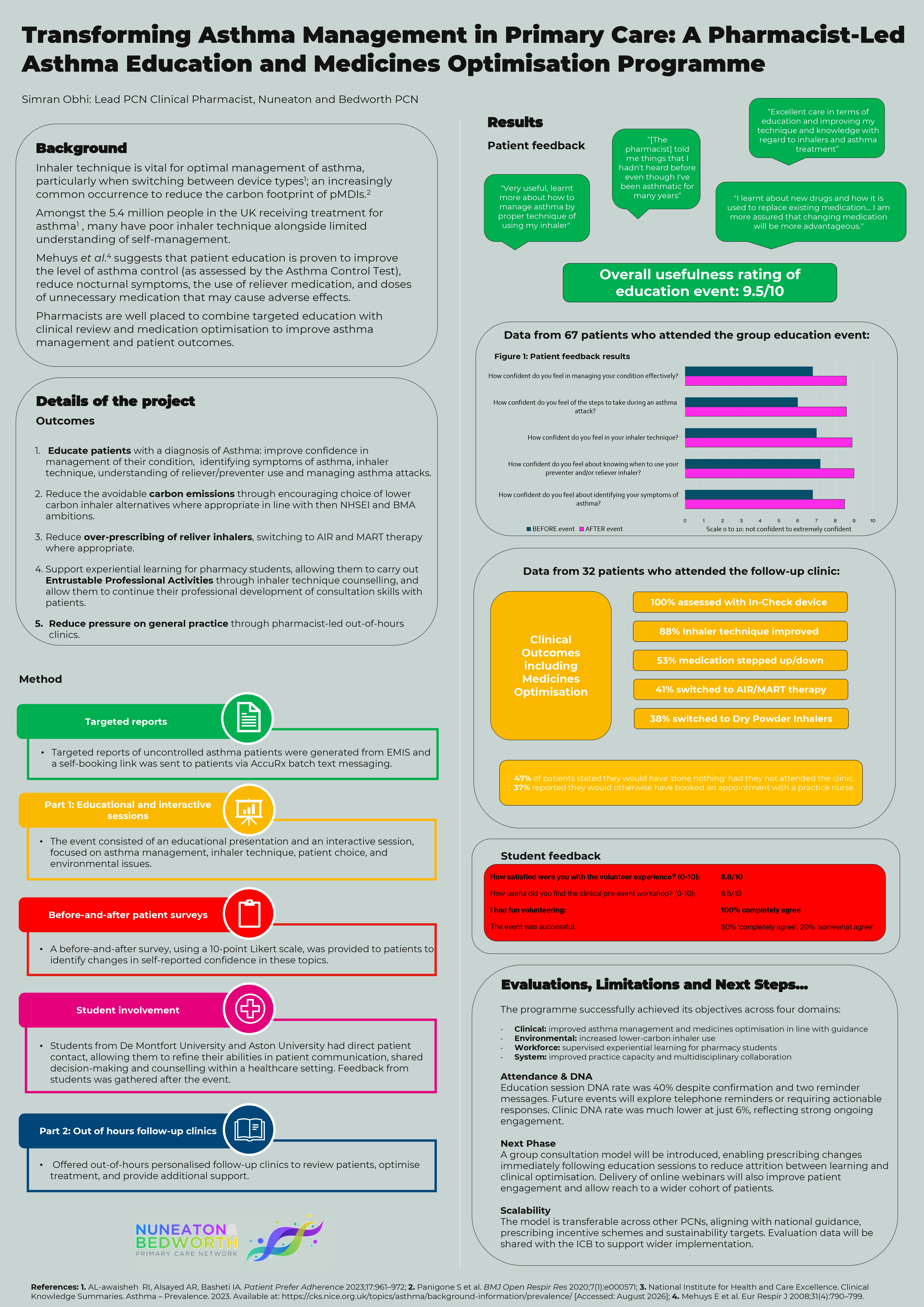
Nuneaton and Bedworth Primary Care Network, serving 11 practices and >100,000 patients, identified adults with poorly controlled asthma through targeted EMIS searches, including patients prescribed ≥6 short-acting beta-agonist (SABA) inhalers annually, receiving SABA-only therapy or inhaled corticosteroid (ICS) monotherapy. This addressed national concerns regarding SABA overuse and aligned with NICE/BTS/SIGN guidance (2024), Integrated Care Board (ICB) priorities to increase Anti-Inflammatory Reliever/Maintenance and Reliever Therapy (AIR/MART) uptake, and reduce high-carbon pressurised metered-dose inhaler (pMDI) prescribing.
A six-month, two-part asthma optimisation programme was developed. Group education sessions improved understanding of asthma, symptom recognition, inhaler technique, acute attack management, and appropriate preventer use, while highlighting the risks of SABA overuse, AIR/MART therapy and lower-carbon dry powder inhalers (DPIs). Pharmacy students delivered inhaler technique counselling as Entrustable Professional Activities, supporting workforce development. Patients then attended pharmacist-led out-of-hours optimisation clinics where medicines were reviewed and optimised.
Evaluation included pre- and post-event confidence scores, patient experience questionnaires, post-clinic satisfaction surveys and clinical outcomes. Using a 10-point Likert scale, patient confidence improved across all domains, with confidence in asthma attack management increasing by 2.6 points, and confidence in inhaler technique by 1.9 points (to 8.9/10). Education sessions were rated 9.5/10 for usefulness. Following clinic review, inhaler technique improved in 88% of patients, medication optimisation occurred in 53%, 41% transitioned to AIR/MART and 38% switched to DPIs. 100% patients would recommend the service, 95% were very satisfied with the advice and care received, and 47% reported they would have taken no action about their asthma care if they had not attended the clinic, highlighting the value of proactive intervention. The programme supported improved prescribing, reduced pMDI use, increased practice capacity through out-of-hours delivery, and enhanced pharmacy student confidence and primary care experience.
Combining patient education with structured optimisation clinics delivers clinical, environmental, and workforce benefits. This scalable model aligns with national guidance, prescribing incentives and NHS sustainability objectives and is readily transferable across other PCNs.
National Institute for Health and Care Excellence (NICE), British Thoracic Society (BTS) and Scottish Intercollegiate Guidelines Network (SIGN) (2024) Asthma: diagnosis, monitoring and chronic asthma management (NG245). London: NICE. Available at: https://www.nice.org.uk/guidance/NG245
Funding: Funded via a Grant/Donation from Orion Pharma
Conflicts of interest: None