Beyond trial outcomes: Process evaluation insights into the IMP2ART trial findings. (ID 840)
University of Edinburgh
Abstract
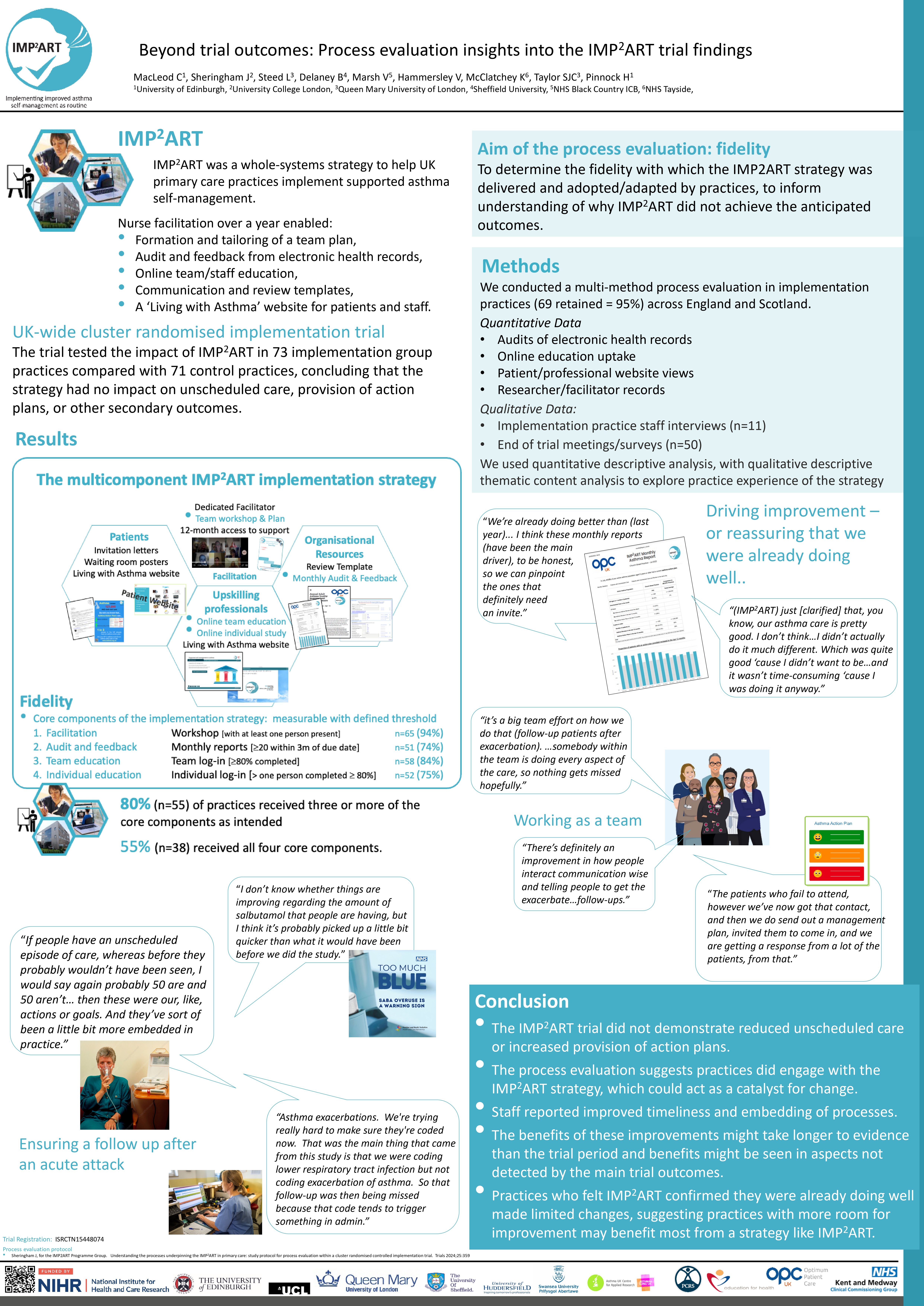
Background: The IMP2ART cluster randomised trial (IMPlementing IMProved Asthma self-management as RouTine) tested a whole-systems strategy to improve implementation of supported asthma self-management in UK primary care. The multi-level programme theory combined implementation and behaviour change frameworks to inform a strategy that included expert nurse facilitation, professional education for general practice staff, regular audit reports from electronic health records, review and communication templates, and a website with resources for patients and staff. The trial, using routine data, concluded that the strategy had no impact on unscheduled care, provision of action plans or other secondary outcomes in a predominantly well-controlled asthma population.
Aim: To determine the fidelity with which the IMP2ART strategy was delivered and adopted/adapted by practices, to inform understanding of why IMP2ART did not achieve the anticipated trial outcomes.
Methods: 73 practices were allocated to the IMP2ART strategy (69 completed). Our comprehensive multi-method process evaluation collected quantitative data (audits of electronic health records, online education uptake, patient/professional website views, researcher/facilitator records), and qualitative data (implementation practice staff interviews (n=11), and end of trial meetings/surveys (n=50)). Analyses, conducted separately for each data source, were triangulated.
Results: The IMP2ART strategy was largely delivered and adopted as intended, with 94% of practices receiving a facilitation workshop, 74% receiving timely monthly audit reports, 84% completing the team education module, and 75% having at least one person complete the individual education module. Staff prioritised and reported seeing improvements in: delivery of asthma reviews; patients attending and engaging with reviews; identification of SABA overuse; follow-ups after steroid use and exacerbations; and involvement of whole/wider team. However, some staff reported making no or limited changes during the trial because they inferred from audit reports and education their asthma care was good and they were “doing it anyway”.
Conclusion: Whilst the main trial findings did not demonstrate impact from the strategy across groups, the process evaluation suggests practices did engage with the strategy, which could act as a catalyst for change. It also suggests that practices with more room for improvement may benefit most from a strategy like IMP2ART.
Funding: The programme was funded by a National Institute for Health and Care Research Programme Grant for Applied Health Research (NIHR RP-PG-1016-20008; ISRCTN 15448074). The Asthma UK Centre for Applied Research (reference Asthma UK: AC-2012-01) funded some pre-grant work on the theoretical development of the implementation strategy. Education for Health developed the education modules and Optimum Patient Care developed the templates and audit and feedback components of the implementation strategy.
Conflicts of interest: None