How health economics can move us beyond efficiency to equity in asthma care: the IMP2ART E study (ID 841)
Swansea University
Abstract
Background and Aim
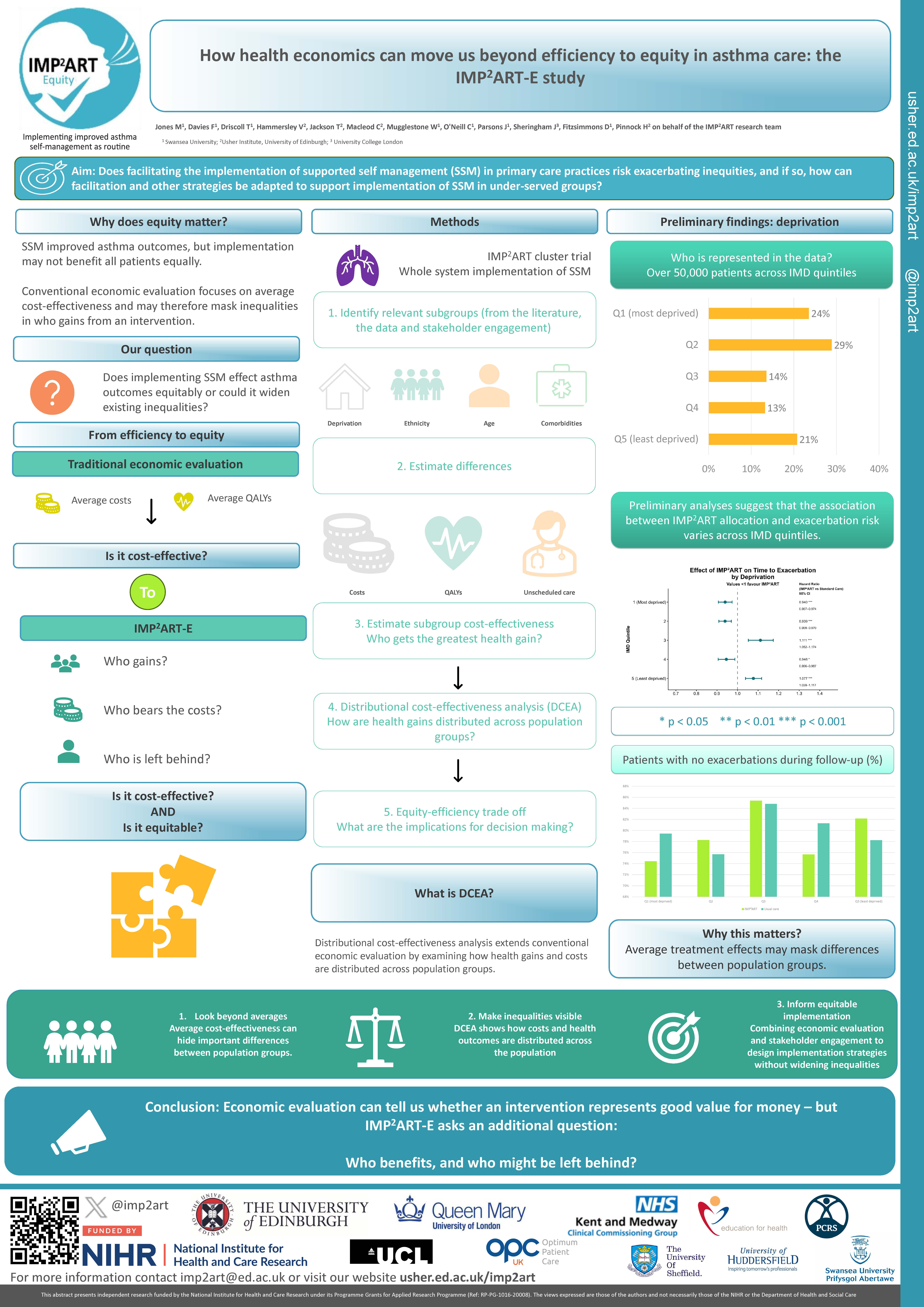
Supported self-management (SSM) improves asthma outcomes, but implementation may not benefit all patients equally. The IMP2ART cluster randomised trial evaluates a whole-system intervention to embed SSM in UK primary care. While conventional economic evaluation focuses on cost-effectiveness, this risks masking unequal distribution of benefits and impacts on health inequalities. The IMP2ART E study extends this work to examine whether implementation reduces or exacerbates inequalities. This abstract outlines how health economics methods can be used to address equity alongside efficiency in asthma care.
Methods
IMP2ART E builds on the trial-based economic evaluation by applying distributional cost-effectiveness analysis (DCEA) to assess how costs and outcomes are distributed across subgroups. Analyses adopt an NHS and Personal Social Services perspective over a 24-months. Outcomes include quality-adjusted life years (QALYs) and unscheduled care.
Equity-relevant subgroups (e.g. deprivation, ethnicity, age, comorbidities) are informed by literature, data availability, and stakeholder engagement. A hierarchical approach will be used: (1) descriptive subgroup analyses, (2) subgroup-specific cost-effectiveness estimates, and (3) integration of qualitative findings to interpret heterogeneity and refine subgroup selection. DCEA will then quantify inequality (e.g. using Atkinson indices) and estimate the trade-off between maximising overall health and reducing inequalities.
Results
Results are pending. However, prior IMP2ART findings suggest variability in implementation and uptake of SSM components across practices, indicating potential for unequal effects. Stakeholder engagement has highlighted key equity concerns, including barriers faced by underserved populations, which have shaped subgroup selection and priorities. Ongoing analysis will examine whether differences translate into unequal distributions of costs, health outcomes and cost-effectiveness. It will quantify the extent to which implementation may reduce or exacerbate health inequalities. Qualitative findings will be integrated with quantitative results to support interpretation of subgroup differences providing insight into the factors influencing the difference in outcomes across population groups.
Conclusions
IMP2ART-E demonstrates how health economic evaluation can move beyond average cost-effectiveness to consider equity in implementation. By combining DCEA with stakeholder and qualitative insights, the study will generate policy-relevant evidence on how implementation strategies can be designed to improve outcomes without widening inequalities. This approach has wider applicability across respiratory and long-term condition management.
Funding: This project was funded by NIHR
Conflicts of interest: None