IMProving IMPlementation of Asthma self-management as Routine (IMP2ART) trial: health economic evaluation (ID 842)
Swansea University
Abstract
Background
Supported asthma self-management is known to improve patient outcomes and quality of life and is recommended in national guidelines, however, implementation in UK primary care is suboptimal. The IMProving IMPlementation of Asthma self-management as Routine (IMP2ART) trial evaluated a whole-systems strategy designed to embed supported asthma self-management in routine primary care practice. The study assessed whether this approach increased asthma action plan provision and reduced unscheduled care episodes compared with usual care. The facilitated implementation strategy included professional training, organisational support, and patient-facing resources.
Aim
To evaluate whether the IMP2ART strategy of facilitated implementation of supported self-management is cost-effective compared to usual asthma care.
Methods
144 general practices (51,335 eligible patients) in England and Scotland were randomised to either the IMP2ART implementation strategy or usual care. Patient outcomes and their associated NHS costs were followed up for 24 months post-randomisation using electronic health record data, with the 12 months prior to randomisation used to establish baseline service use.
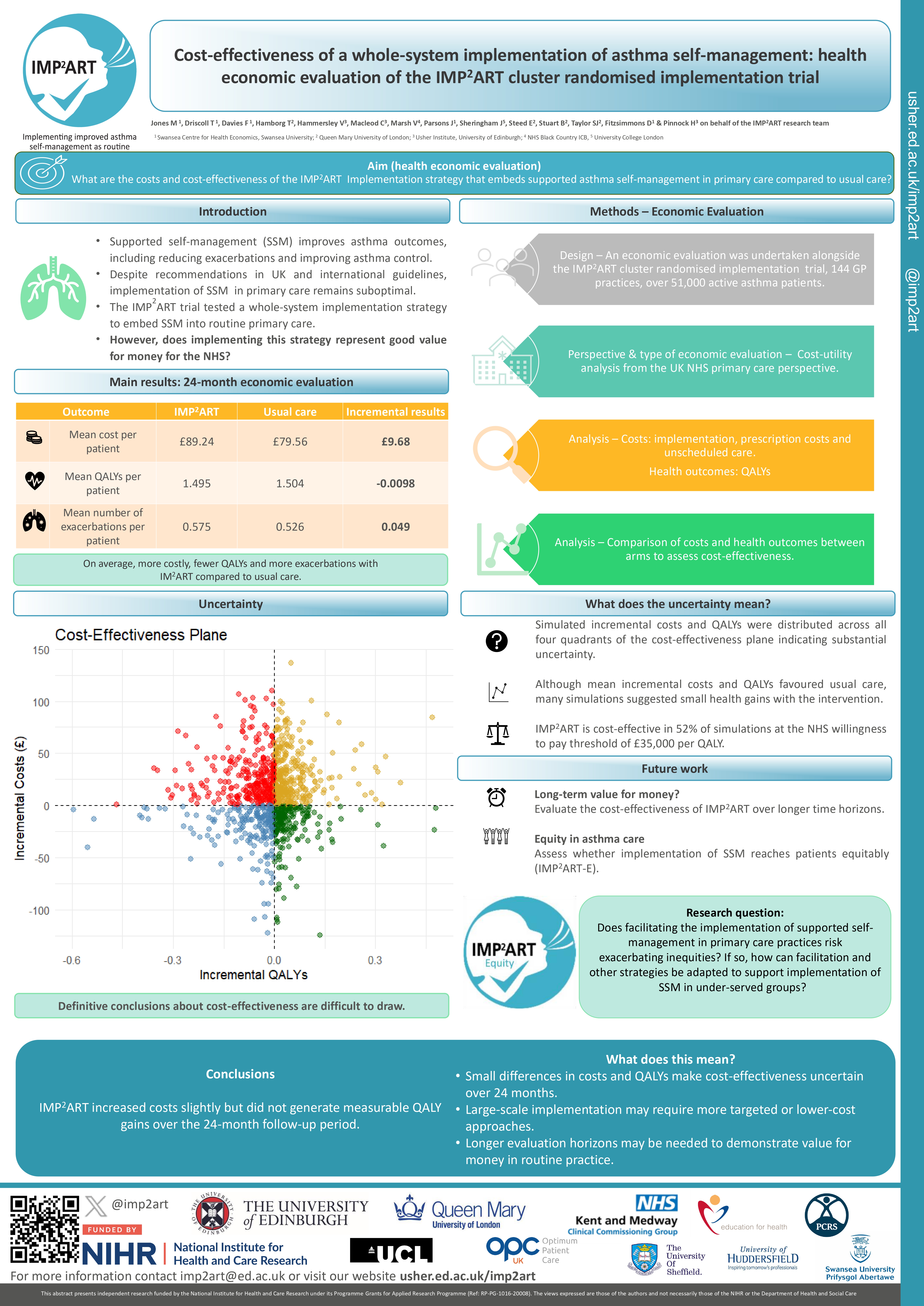
The economic evaluation compared NHS resource use and quality-adjusted life years, both discounted at an annual rate of 3.5%. Incremental cost-effectiveness ratios were calculated, and probabilistic sensitivity analyses and model-based analyses undertaken.
Results
Mean costs per patient were higher for the IMP2ART implementation group than usual care (£92.63 vs £80.39; incremental cost £12.24), while quality-adjusted life years were comparable (1.520 vs 1.523; incremental difference -0.003). The incremental cost-effectiveness ratio was -£4,134, indicating usual care dominated. The probability that the IMP2ART implementation strategy was cost-effective at standard UK NICE willingness-to-pay thresholds was low: approximately 40% at £25,000 per quality-adjusted life year.
Sensitivity analyses and model-based analyses were consistent with base-case findings.
Conclusion
The IMP2ART supported asthma self-management intervention was more costly than usual care with no measurable improvement in patient outcomes over 24 months. However, cost effectiveness is uncertain due to the small differences observed between groups[JS1.1] and the possibility that control practices were investing more resources than we estimated due to inclusion of supported self-management in QOF. Large scale implementation may require more targeted approaches, and consideration of longer follow-up periods, to demonstrate value for money.
Funding: This project was funded by NIHR
Conflicts of interest: None