Modifiable Risk Factors in patients referred to Severe Asthma Services: Implications for Primary Care Education and Referral
Could medicine optimisation and improved patient adherence in primary care reduce the number of patients referred to the secondary care difficult asthma service? (ID 802)
National Services for Health Improvement
Abstract
Background
NSHI delivers nurse-led triage for patients referred to Centres for Severe Asthma (CSA) in eight NHS Trust and Health Boards in England and Wales. Many of these patients did not meet the GINA definition for difficult/severe asthma¹ This study aims to identify whether further intervention and support could reduce the number of referrals to secondary care.
Clinical Context
Non-adherence to or, inadequate medication, smoking, GORD, and absence of Personalised Asthma Action Plan (PAAP) are strongly associated with asthma morbidity and preventable admissions¹²³. These factors can be identified and treated in Primary Care if adequate support were provided for Primary Care clinicians.
Method
Patients were reviewed by respiratory nurses trained in difficult/severe asthma. Patient data on modifiable risk factors (MRF) and interventions were collected between Jan-Dec 2025 on patients reviewed in eight centres.
Data included nine MRF (see table 1).
Data was analysed to define whether identifying and treating modifiable risk factors (MRF) including medicine optimisation, which could be treated in Primary Care, could reduce admissions/referrals.
Results
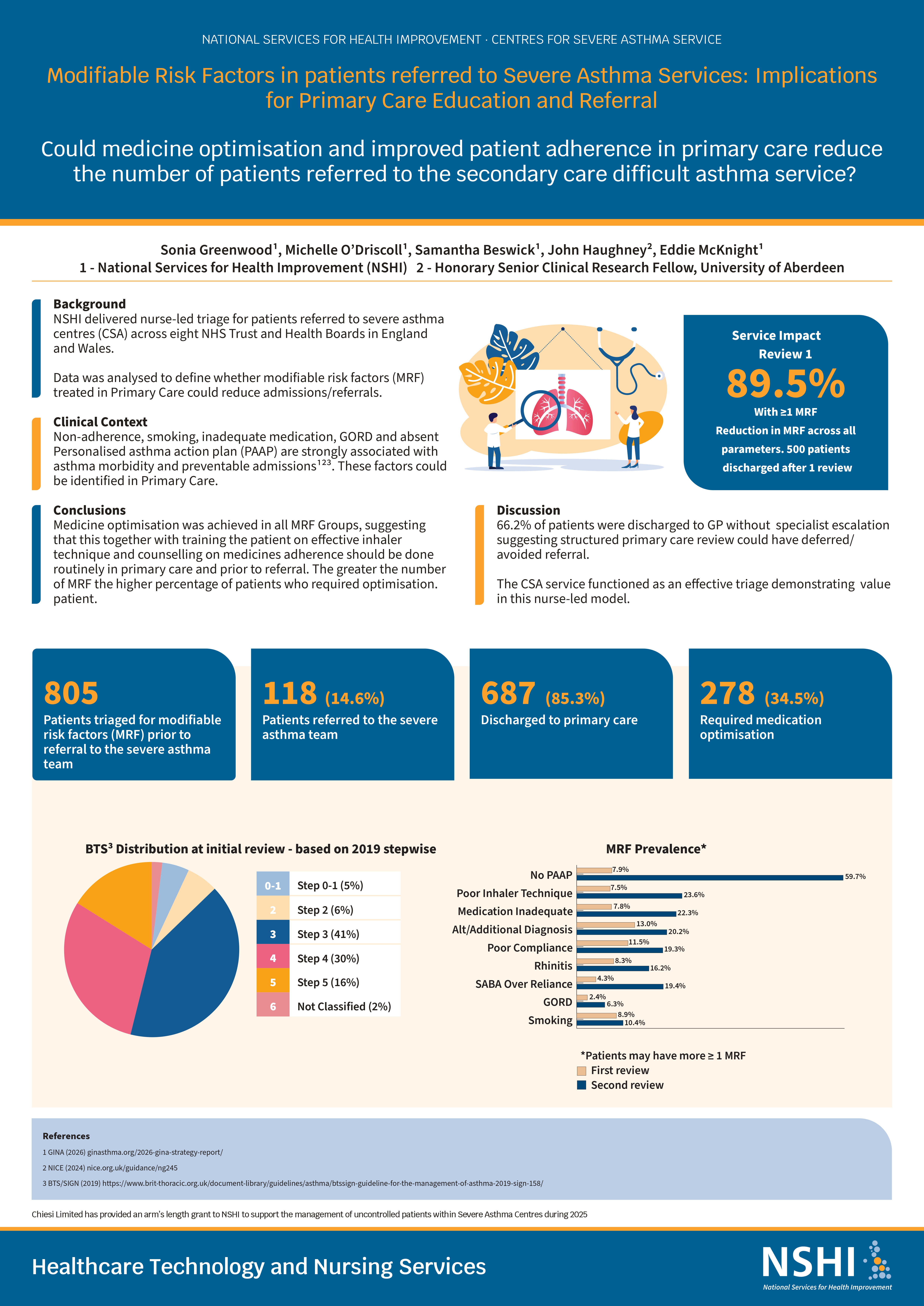
805 patients were reviewed. 46% percent of patients were at step 4/5 of the BTS/SIGN² guidelines, putting them in the potential difficult asthma group¹ (see table 1). MRF prevalence improved significantly at second review. (See table 2). This was highest in the “No personal asthma action plan (PAAP),” “poor inhaler technique” and “medication inadequate” groups. There was an 89.5% reduction across all MRF at second review. 500 patients were discharged after their initial appointment. 278 (34.5%) patients required medicine optimisation. Only 118 (14.6%) of patients received onward referral to the severe asthma service.
Conclusion
66.2% of patients were discharged to their GP without specialist escalation suggesting structured primary care review could have deferred/avoided referral.
The CSA service functioned as an effective triage demonstrating value in this nurse-led model.
Further analysis of the data collected including patient demographics will enable the authors to have a clear understanding of other factors that affect patient admissions and referrals such as deprivation and socioeconomic status.
References
1 GINA (2026) ginasthma.org/2026-gina-strategy-report/
2 NICE (2024) nice.org.uk/guidance/ng245
3 BTS/SIGN (2019) https://www.brit-thoracic.org.uk/document-library/guidelines/asthma/btssign-guideline-for-the-management-of-asthma-2019-sign-158/
Funding: Chiesi Limited has provided an arm’s length grant to NSHI to support the management of uncontrolled patients within Centres for Severe Asthma during 2025
Conflicts of interest: None