Operational performance of an artificial intelligence-enabled diagnostic service for chronic obstructive pulmonary disease in primary care (ID 806)
GP Primary Choice
Abstract
Introduction and Objectives
The quality of primary care spirometry can be compromised by operator variability and interpretive errors. While ARTP accreditation aims to ensure quality, its demanding certification standards create workforce challenges, leaving primary care spirometry often unable to meet diagnostic demand.
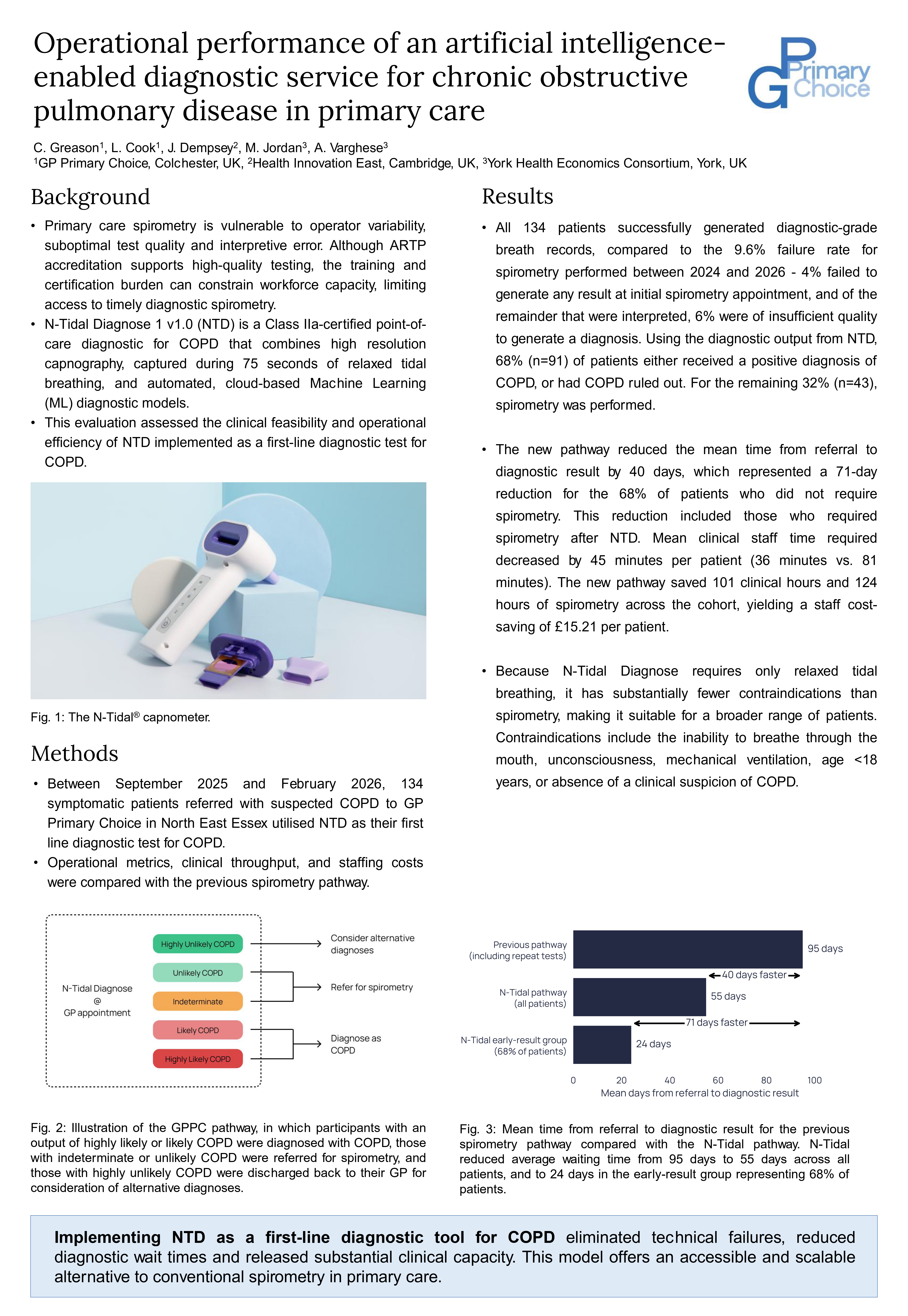
This evaluation assessed the clinical feasibility and operational efficiency of N-Tidal® Diagnose 1 (NTD) when it was implemented as a first-line diagnostic test for chronic obstructive pulmonary disease (COPD). NTD offers a point-of-care diagnosis for COPD by combining high resolution capnometry, captured during 75 seconds of relaxed tidal breathing and automated, cloud-based Machine Learning diagnostic models.
Methods
Between September 2025 and February 2026, 134 symptomatic patients referred with suspected COPD to GP Primary Choice in North East Essex utilised NTD as their first line diagnostic test for COPD. Operational metrics, clinical throughput, and staffing costs were compared with the previous spirometry pathway.
Results
All 134 patients successfully generated diagnostic-grade breath records, yielding a 0% failure rate compared to 9.6% failure rate of the spirometry performed between 2024-2026 - 4% failed to generate any result at initial spirometry appointment, and of the remainder that were interpreted, 6% were of insufficient quality to generate a diagnosis.
Using the diagnostic output from NTD, 68% (n=91) of patients either received a positive diagnosis of COPD, or had COPD ruled out. For the remaining 32% (n=43), spirometry was performed. The new pathway reduced the mean time from referral to diagnostic result by 40 days, which represented a 71-day reduction for the 68% of patients who did not require spirometry. This reduction included those who required spirometry after NTD. Mean clinical staff time required decreased by 45 minutes per patient (36 minutes vs. 81 minutes). The new pathway saved 101 clinical hours and 124 hours of spirometry across the cohort, yielding a staff cost-saving of £15.21 per patient.
Conclusions
Implementing NTD as a first-line diagnostic tool for COPD eliminated technical failures, reduced diagnostic wait times, and released substantial clinical capacity. This model offers an accessible and scalable alternative to conventional spirometry in primary care.
Funding: This evaluation was funded by Health Innovation East
Conflicts of interest: None