Disease Stability is Achievable in a Wide Spectrum of Patients with Chronic Obstructive Pulmonary Disease Receiving Mepolizumab: Pooled Results From Phase III Randomized Controlled Trials (ID 816)
GSK
Abstract
Rationale: Chronic obstructive pulmonary disease (COPD) activity includes exacerbations, which drive disease progression, characterized by worsening symptoms and deteriorating lung function. Disease stability, defined as a sustained state of low disease activity following optimization of management, is an emerging, ambitious and achievable treatment goal in COPD. Mepolizumab is an approved add-on maintenance treatment for adults with COPD and an eosinophilic phenotype.
Methods: METREX (GSK ID: 117106/ClinicalTrials.gov identifier: NCT02105948), METREO (117113/NCT02105961), and MATINEE (208657/NCT04133909) were Phase III RCTs assessing the efficacy of mepolizumab 100 mg versus placebo in patients with COPD, a history of exacerbations, and receiving triple therapy. This pooled post hoc analysis in patients with blood eosinophil count (BEC) ≥300 cells/µL at screening, evaluated disease stability in the overall population (N=1146) and by Global Initiative for Chronic Obstructive Lung Disease (GOLD) status. Disease stability at Week 52 was defined as a three-component composite endpoint of 1) no moderate/severe exacerbations (‘exacerbations’); 2) ≤0 change from baseline in COPD Assessment Test scores (‘health status’); 3) ≥0mL change from baseline in forced expiratory volume in 1 second (‘lung function’).
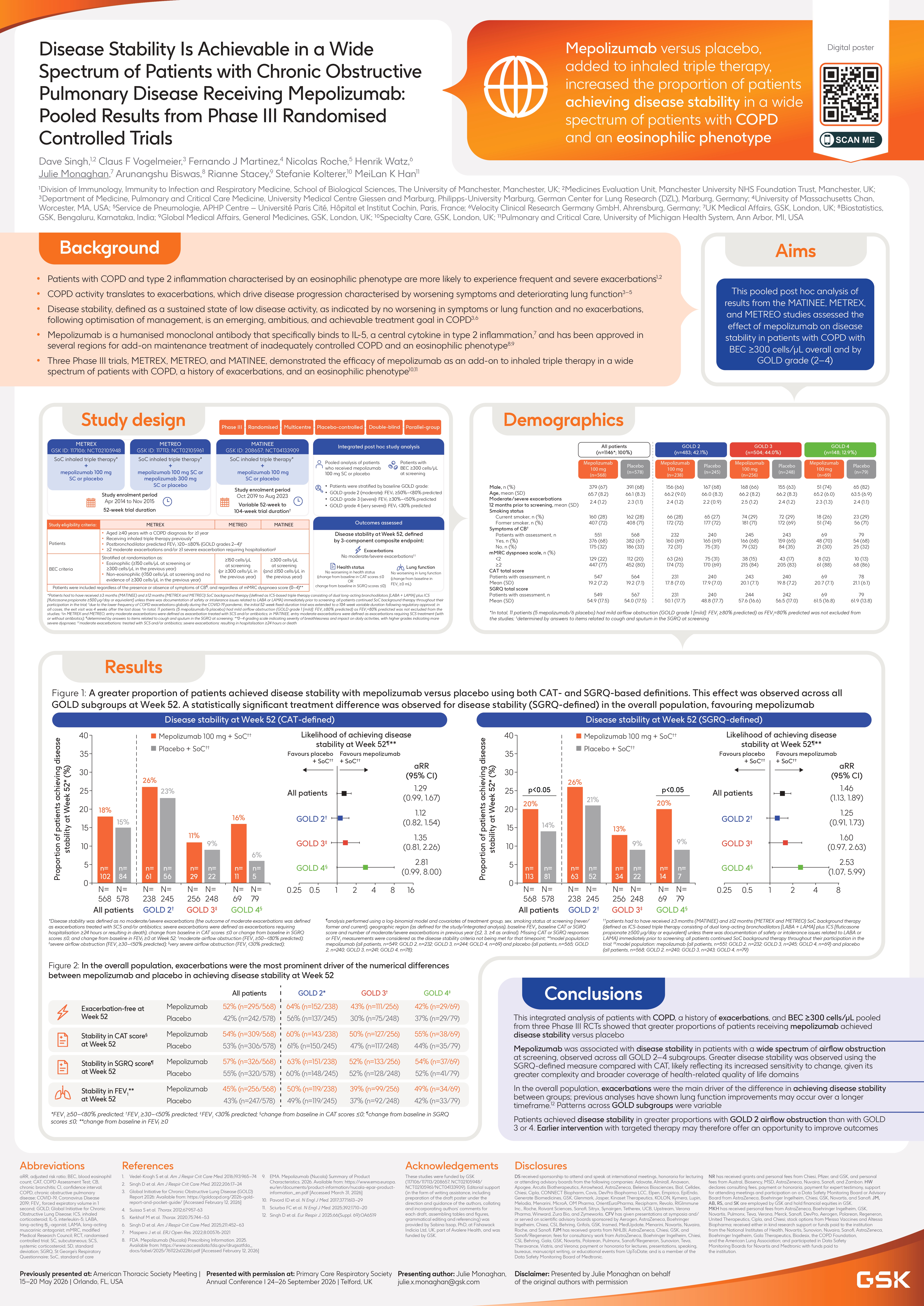
Results: At Week 52, disease stability was achieved by more patients receiving triple therapy treated with mepolizumab versus placebo (18% [102/568] vs 15% [84/578]). Among the individual components, exacerbations were the most prominent driver of the numerical difference in achieving disease stability between groups, with the following rates of achieving disease stability criteria: exacerbations (52% [295/568] vs 42% [242/578]); health status (54% [309/568] vs 53% [306/578]) and lung function (45% [256/568] vs 43% [247/578]). There were more patients achieving disease stability with mepolizumab versus placebo across all GOLD subgroups (GOLD 2: 26% vs 23%, GOLD 3: 11% vs 9%, and GOLD 4: 16% vs 6%) (Figure).
Conclusions: Patients with COPD and BEC ≥300 cells/µL receiving triple therapy treated with mepolizumab achieved disease stability in greater proportions than those receiving placebo. Disease stability is therefore achievable with mepolizumab in patients otherwise poorly controlled on triple therapy, with a wide spectrum of COPD presentations.
Funding: GSK (117106/117113/208657).
Previously presented at ATS 2026.
Funding: This study was funded by GSK.
Conflicts of interest: DS received sponsorship to attend and speak at international meetings, honoraria for lecturing or attending advisory boards from the following companies: Adovate, Almirall, Anaveon, Apogee, Arcutis Biotherapeutics, Arrowhead, AstraZeneca, Belenos Biosciences, Bial, Celldex, Chiesi, Cipla, CONNECT Biopharm, Covis, DevPro Biopharma LCC, Elpen, Empirico, EpiEndo, Generate Biomedicines, GSK, Glenmark, Jasper, Kinaset Therapeutics, KOLON, Kymera, Lupin, Melodia, Menarini, MicroA, OM Pharma, OrientEuroPharma, Recipharm, Revolo, RIGImmune Inc., Roche, Roivant Sciences, Sanofi, Sitryx, Synairgen, Tetherex, UCB, Upstream, Verona Pharma, Winward, Zura Bio, and Zymeworks.
CFV has given presentations at symposia and/or served on scientific advisory boards sponsored by Aerogen, AstraZeneca, Boehringer Ingelheim, Chiesi, CSL Behring, Grifols, GSK, Insmed, MedUpdate, Menarini, Novartis, Nuvaira, Roche, and Sanofi.
FJM has received grants from NHLBI, AstraZeneca, Chiesi, GSK, and Sanofi/Regeneron; fees for consultancy work from AstraZeneca, Boehringer Ingelheim, Chiesi, CSL Behring, Gala, GSK, Novartis, Polarean, Pulmonx, Sanofi/Regeneron, Sunovion, Teva, Theravance, Viatris, and Verona; payment or honoraria for lectures, presentations, speaking, bureaus, manuscript writing, or educational events from UpToDate; and is a member of the Data Safety Monitoring Board of Medtronic.
NR has received grants and personal fees from Chiesi, Pfizer, and GSK, and personal fees from Austral, Biosency, MSD, AstraZeneca, Nuvaira, Sanofi, and Zambon.
HW declares consulting fees, payment or honoraria, payment for expert testimony, support for attending meetings and participation on a Data Safety Monitoring Board or Advisory Board from AstraZeneca, Boehringer Ingelheim, Chiesi, GSK, Novartis, and Sanofi.
JB, AB, RS, and SK are employed by GSK and hold financial equities in GSK.
MKH has received personal fees from AstraZeneca, Boehringer Ingelheim, GSK, Novartis, Pulmonx, Teva, Verona, Merck, Sanofi, DevPro, Aerogen, Polarean, Regeneron, United Therapeutics, Cipla, and Chiesi; stock options from Meissa Vaccines and Altessa Biopharma; received either in kind research support or funds paid to the institution from the National Institutes of Health, Novartis, Sunovion, Nuvaira, Sanofi, AstraZeneca, Boehringer Ingelheim, Gala Therapeutics, Biodesix, the COPD Foundation, and the American Lung Association; and participated in Data Safety Monitoring Boards for Novartis and Medtronic with funds paid to the institution.