Transforming COPD Care across the Humber: proactive identification and risk management across the care pathway (Humber COPD ProCare) (ID 818)
NHS Humber Health Partnership
Abstract
Background
Chronic Obstructive Pulmonary Disease (COPD) is common, preventable and treatable, yet it remains a major driver of healthcare use and premature mortality. The respiratory transformation partnership aims to support early and accurate diagnosis and risk-based optimisation for people with asthma and COPD. In 2025, pathway transformation funding was made available to a number of health systems in England to achieve these goals. We report the implementation of a preventative, neighbourhood-based care model focused on early and accurate diagnosis, digital risk stratification, and proactive optimisation.
Methods
Humber-COPD-ProCare was implemented between October-2025 and March-2026 and comprised of: i) workforce training to support asthma and COPD diagnosis, ii) lung cancer screening-aligned COPD case-finding, iii)the OPTIMISE model for identification and holistic optimisation of high-risk COPD patients, iv) integrated community COPD MDT access, and iv) respiratory virtual ward delivered exacerbation support. Data were collected using an electronic data capture tool. Here we report descriptive data from the COPD case-finding and OPTIMISE programme components.
Results
COPD Case-finding: 393 people attended one-stop diagnostic appointments with a respiratory nurse specialist and 237 were diagnosed with COPD (median [range] age 69 [46-79], 154 [65%] male, 109 [46%] current smokers). Those diagnosed with COPD had GOLD Stage 1 – 129 (54%), 2 – 96 (41%), 3 – 10 (4%), and 4 – 1 (<1%). 144 (61%) patients had a CAT score ≥10 and 231 (97%) started guideline informed inhaled therapy.
OPTIMISE: The OPTIMISE Ardens search tool identified 2,067 high-risk patients across 12 primary care networks. 483 OPTIMISE reviews were completed during the programme, with data available for 423 (mean [SD] age 68.7 years, 176 [42%] male, 139 [33% current smokers], 335 (79%) CAT score ≥10. Pre-review, 287 (68%) were prescribed single inhaled triple therapy, increasing to 303 (72%) post-review. 70 of 308 participants with sufficient data to assess potential biologics eligibility met existing NICE criteria.
Conclusions
Lung cancer screening-aligned COPD case-finding and the OPTIMISE model both represent pro-active, risk-based approaches that align with the NHS’s strategic ambitions. Adopting a whole system approach offers opportunities to improve the patient pathway and outcomes for people living with diagnosed and undiagnosed COPD.
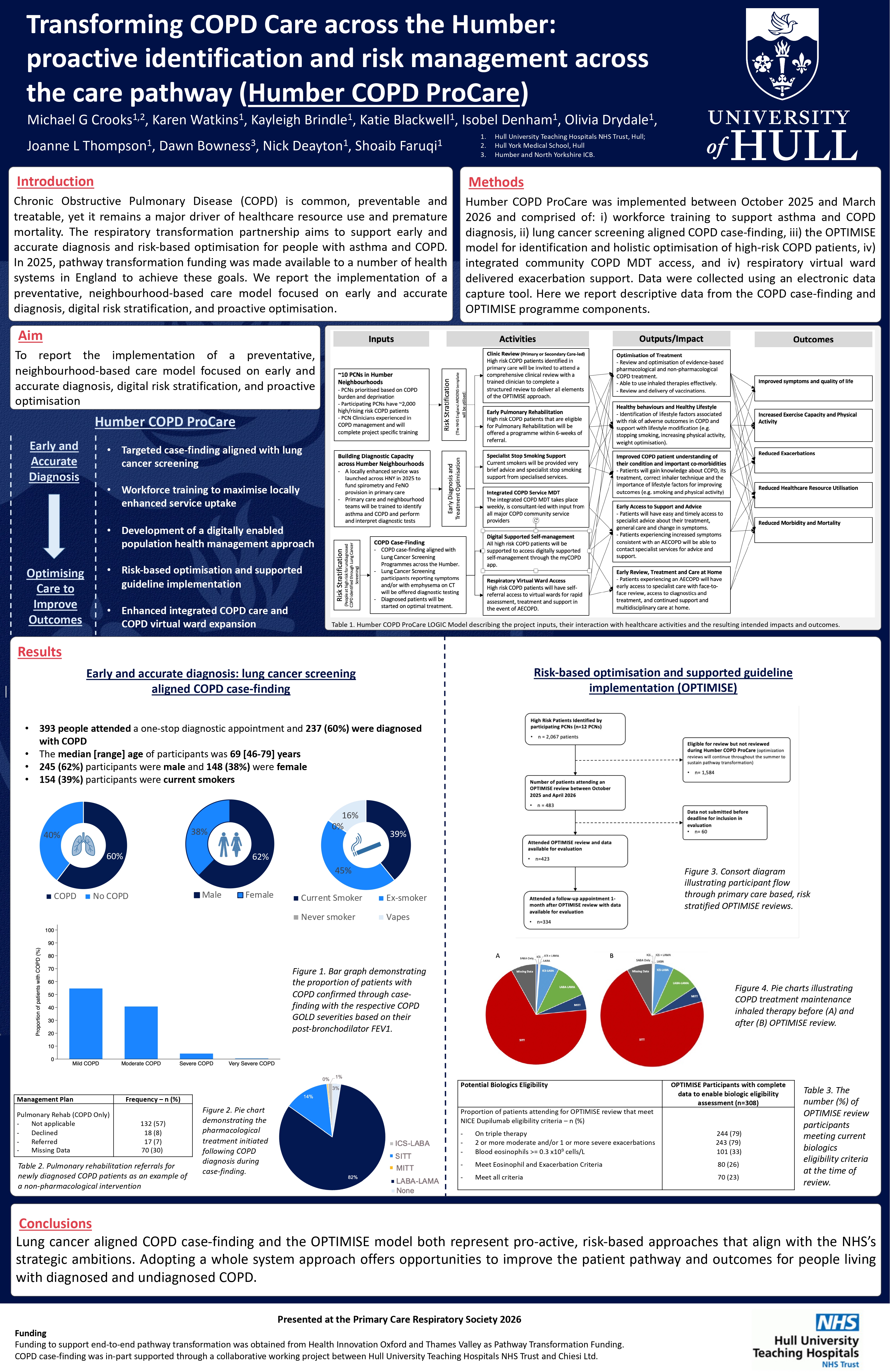
Funding: Funding to support end-to-end pathway transformation was obtained from Health Innovation Oxford and Thames Valley as Pathway Transformation Funding. COPD case-finding was in-part supported through a collaborative working project between Hull University Teaching Hospitals NHS Trust and Chiesi Ltd.
Conflicts of interest: Michael G Crooks has received grants from the National Institute for Health and Care Research, Asthma + Lung UK, AstraZeneca, Boehringer Ingelheim, Chiesi, Phillips, and Pfizer; honoraria, fees and/or non-financial support from AstraZeneca, Boehringer Ingelheim, Chiesi, GlaxoSmithKline, Orion, Novartis, Pfizer, Synairgen and Sanofi.