A Breath of Fresh AIR: A Two-Cycle Primary Care Service Improvement Project to Reduce SABA Monotherapy (ID 827)
Pioneer Medical Group
Abstract
Context:
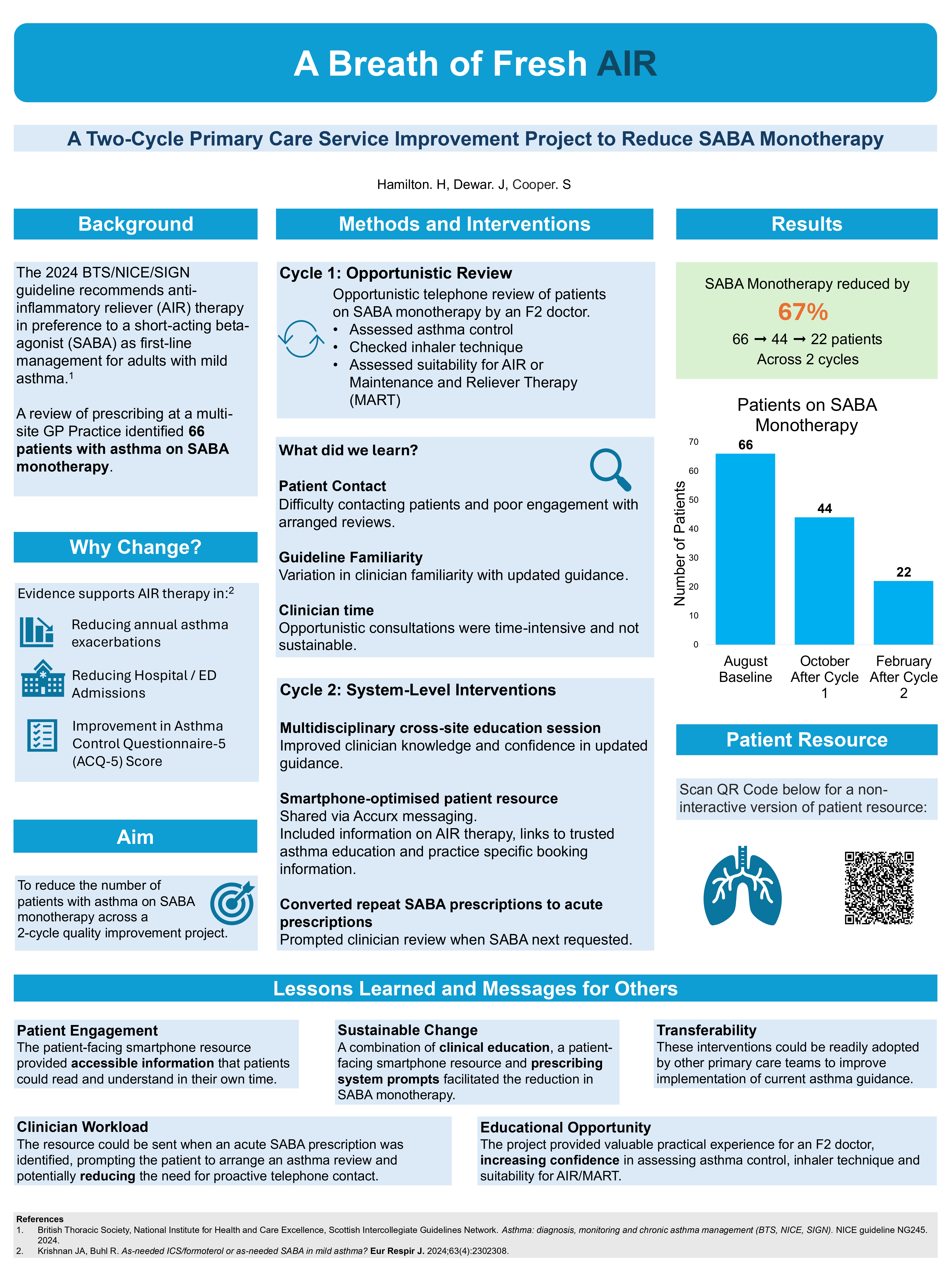
Updated NICE guidance recommends anti-inflammatory reliever (AIR) therapy in place of short-acting beta-agonist (SABA) monotherapy as first-line treatment for adults with asthma. A review of prescribing across a multi-site GP practice identified 66 patients with mild asthma receiving SABA monotherapy.
Issue:
For this cohort, prescribing was not aligned with current guidance, potentially resulting in adverse asthma outcomes and increased risk of exacerbations.
Analysis:
Following initial review, barriers to change included difficulty contacting patients, poor engagement with asthma reviews, and variation in clinician familiarity with updated asthma guidance.
Strategy for Change:
The first improvement cycle involved opportunistic telephone reviews of patients on SABA monotherapy. Asthma control, inhaler technique, and suitability for AIR or Maintenance and Reliever Therapy (MART) were assessed.
To address barriers identified during the first cycle, a second cycle of interventions was implemented. This included a multidisciplinary cross-site education session, development of a smartphone-optimised patient information resource for distribution via Accurx messaging, and conversion of repeat SABA prescriptions to acute prescriptions to prompt clinician review when next requested. The smartphone resource contained information on AIR therapy, links to trusted asthma education materials, and practice-specific booking information.
Measurement of Improvement:
The primary outcome measure was the number of patients with asthma prescribed SABA monotherapy. Re-audit was undertaken following the first cycle and repeated four months following implementation of second-cycle system-level interventions.
Effects of Change:
Following the first cycle, the number of patients receiving SABA monotherapy reduced from 66 to 44. Four months after implementation of second-cycle interventions, only 22 patients remained on SABA monotherapy. Across two cycles, the number of patients receiving SABA monotherapy for asthma reduced from 66 to 22 (67%).
Lessons Learned and Messages for Others:
Opportunistic patient review alone produced initial improvement but was limited by poor patient engagement and the clinician time required to contact patients, making this approach difficult to maintain within routine practice. Sustainable change was achieved through system-level interventions. A combination of clinical education, patient-facing smartphone resources, and prescribing-system prompts reduced SABA monotherapy. These interventions could be readily adopted by other primary care teams to improve implementation of current asthma guidance.
Funding: None
Conflicts of interest: None