Integrated Therapy for Breathlessness & Cough: Why Speech & Physiotherapy belong in neighbourhood care. (ID 855)
South Tyneside and Sunderland NHS Foundation Trust
Abstract
Chronic breathlessness and cough are the leading drivers of emergency care utilisation and place a disproportionate burden on communities experiencing high levels of socieo-economic deprivation. In South Tyneside & Sunderland, where health inequalities are significant, traditional single speciality pathways often fail to address the complex, multifactorial nature of these symptoms. The Assessment of Breathing Clinic (ABC) was developed as a multidisciplinary model embedding Speech & Language Therapy (SALT) and Physiotherapy as integral components of holistic, patient centred care and may be viewed as a foundation for neighbourhood-based models of care.
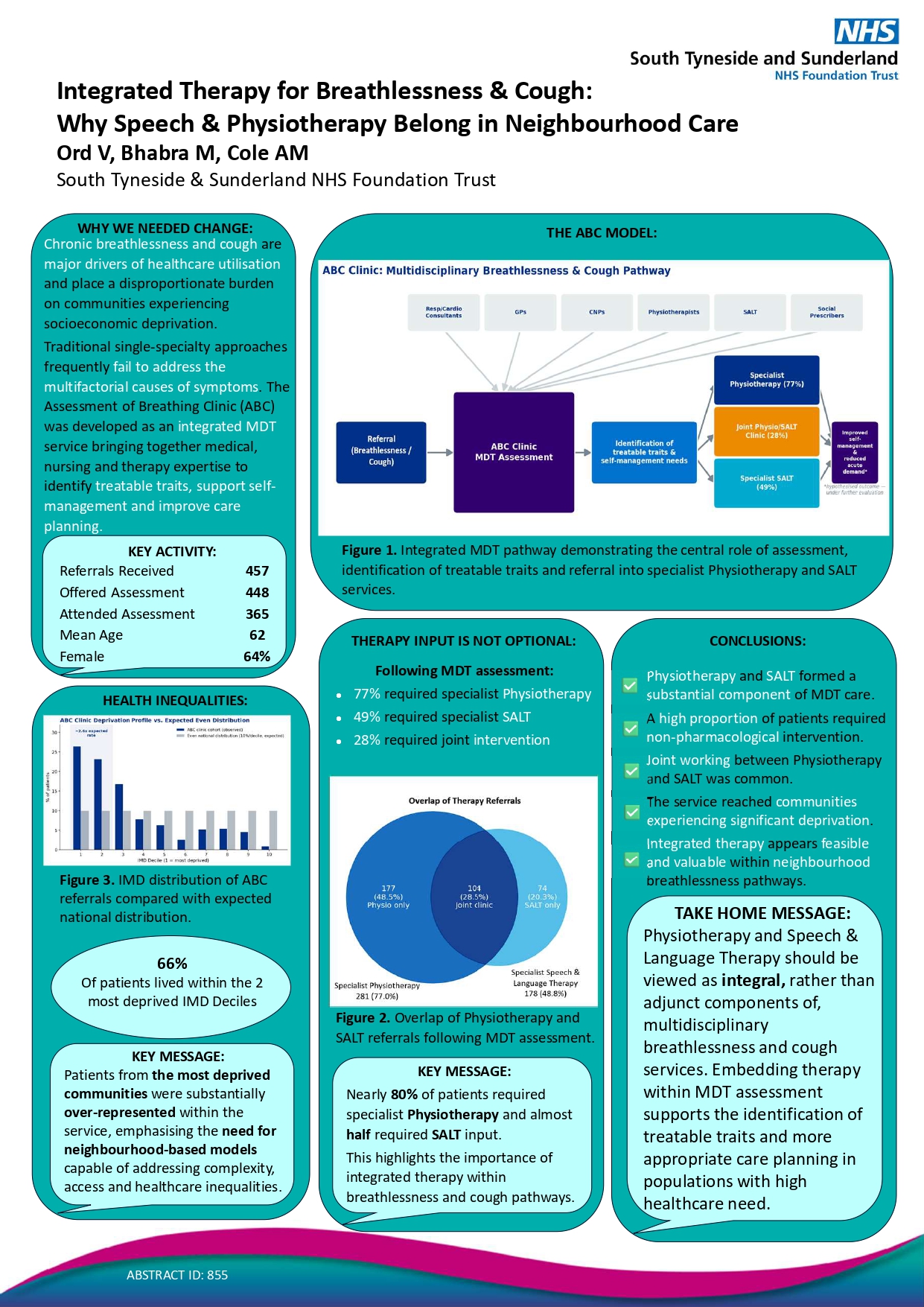
The ABC integrates Respiratory and Cardiology Consultants, General Practitioners, Clinical Nurse Practitioners, Physiotherapists, SALT, and Social Prescribers. The service focuses on identifying treatable traits, supporting self-management and preventing avoidable healthcare utilisation.
Over a 12-month period, the service received 457 referrals for patients with chronic breathlessness / cough symptoms, with 448 patients offered assessments and 365 attending. The cohort was predominantly female (64%), with a mean age of 62 years. A marked deprivation gradient was observed with 66% of patients residing in the two most deprived Index of Multiple Deprivation (IMD) deciles.
Therapy formed a substantial component of the MDT model. Of patients assessed, 77% were referred to specialist Physiotherapy, 49% to specialist SALT and 28% required joint therapy input. Within the Physiotherapy pathway, 225 patients attended assessment, 135 completed treatment and 67 remain in active management.
These findings suggest that Physiotherapy & SALT are integral rather than adjunct components of effective breathlessness and cough pathways. The high proportion of patients requiring therapy input highlights the burden of non-pharmacological and treatable traits within this cohort. The marked deprivation gradients indicate this model may be particularly relevant for populations experiencing socioeconomic disadvantage, where access to timely respiratory care is often limited and reliance on acute services is higher. Embedding therapy within MDT assessment may therefore support earlier identification of non-pharmacological needs and more appropriate care planning. Further work is required to evaluate impact on healthcare utilisation and patient reported outcomes; however early service data supports the feasibility and value of integrated therapy led input within MDT pathways in high need communities.
Funding: None.
Conflicts of interest: Co-Author Cole AM (Dr Anne-Marie Cole) is a committee member of the PCRS.